Tuesday, 20 November 2012

Some final photos from Sinai

ANNOUNCEMENT: If you haven't already seen, the 2013 Wild Ocean Photography calendars are now available for pre-ordering, but you'll need to get in quick as I will be ordering them from the printers over the weekend (24th Nov). For more information check out the link here: http://www.wildoceanphotography.com/2013-calendars

----------------------------------

I have no idea where all the time has gone, but the last two weeks have flown by! We worked hard while we were out in Egypt, snorkeling or diving twice a day and often finishing up with project work or classes for the students in the evenings, but it was brilliant to get a break from the PhD and work on something completely different for a bit. Now I'm back I'm feeling like I've actually had a holiday for the first time in a long time and I've got a lot of my enthusiasm for diving back again!

Anyway, before I put the Red Sea trip to bed, I've got a few final shots to share with you from the last few days. I mentioned before that my group were studying anemonefish behaviour (looking at whether or not they exhibit selective aggression against particular fish species) and it would be rude to leave without at least one or two shots of the charismatic little beasties!

Anemonefish guarding their anemone from me and my camera 

An anemonefish hiding in a bubble anemone

Two anemonefish protecting their anemone-in-a-tyre territory patch

Spot the scorpionfish...
A goby on a massive coral

A ghost crab we found on the beach after snorkeling

Sadly not everything we saw was awesome. I genuinely thought this plastic bag was a jellyfish until I was a couple of metres away - no harm done to me, but it's worse for sea turtles which eat them (jellyfish are a big part of their diet) and clog up their digestive tracts with the plastic. 

Also, on our penultimate day of the trip, the guys at the iDive dving centre where we were staying took us out for an early morning dive at the 'Canyon' dive site which is one of Dahab's most famous (and popular) dives.

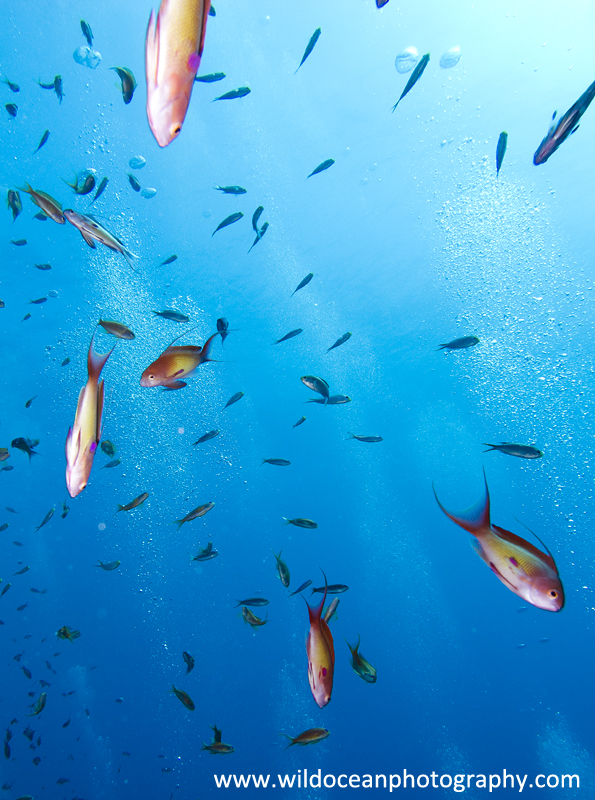
Anthias gathering around a crack in the rocks. 

Fortunately the early start meant we avoided the rush of people who visit it every day and we almost had the place to ourselves. The dive itself involves a shallow swim at about 10m or so across a relatively poor reef (the high diver traffic seems to have degraded the reef quite a lot compared to sites like Gabr el-Bint which we visited on our day off), to a 2m x 2m-ish hole leading straight down into the ground and dropping to around 25m. From there you follow a semi-enclosed canyon (there's light coming down from above, but you couldn't squeeze out that way) down to an exit point at 40m.

Entering the canyon

Descending into the canyon

Looking up to the outside world. Only the bubbles get out that way! 

It's relatively dark and a little spooky, but if you like caves it's a must-see! Unfortunately, being at 40m meant I was suffering somewhat from nitrogen narcosis (and a little bit out of my tree!) which meant most of the photos I took weren't particularly good. Also, although the camera housing is rated to 40m, apparently there isn't much of a depth buffer built in and by the time we were back at 10m there was a small but significant amount of seawater inside and the housing was all fogged up. I'm pretty sure it should be able to cope with the depth it's rated to so I'm not massively impressed with that I must admit. The good news is that the camera at least is fine, but I didn't get many shots from that dive!

Sergeant majors feeding in the surface waters

Finally after all that, it was time to go home and head back to Glasgow feeling exhausted, salty, tanned and pretty damn good! There's nothing like a good break and a bit of summer sun to give you a bit of a boost! But I'm not back for long - next Thursday I'm heading to Wellington, New Zealand to attend and present at the 13th International Deep Sea Biology Symposium which should be awesome, and then I'm spending 10 days or so travelling around the south island a bit (probably. I've not really planned anything yet) and hopefully doing some above-water wildlife photography on the way. If I can blog about it I will, but at the very least I'll get something up when I get back.


Wednesday, 14 November 2012

Ras Mohamed National Park, Nabq and Diving!

Yeah, my job is pretty awesome.

So like I said last time, I'm currently helping out on a Tropical Marine Ecology field course to the Red Sea with the University of Glasgow and so far it's been pretty stunning! The first week was spent largely getting everyone used to snorkeling around the local shallow reefs and learning how to conduct various underwater surveys (transects and point counts and the like) and being shown the different environments that are typical of tropical systems. To really show them what the coral reefs of the Red Sea can be like, we took a trip down to the Ras Mohamed national park at the southern tip of the Sinai peninsula for a couple of days, sleeping in a Bedouin camp and seeing what the place had to offer.

As always, please click on the images to see them full size (and nicer looking!).

Our camp for a couple of days at Ras Mohamed

We're definitely in Egypt.

It turns out it was quite a lot! The waters where we were staying dropped to over 800m within a short distance of the shore, so we were treated to some stunning drop-offs as the reefs disappeared off into the depths, as well as an abundance of fish and coral life. The photo opportunities were stunning and the water was clear enough to make it almost easy to take some really nice shots.

Looking over a shallow reef flat in Ras Mohamed.

Fire corals and amazing underwater visibility in Ras Mohamed.

One of our students snorkeling across the reef

The park was jammed full of fish and corals and the water clarity made photography almost simple!

After two amazing snorkels in the blue, we got to do a (freezing cold) night dive to see the nighttime behaviours of the reef inhabitants which was also awesome! Although it was far too dark for photography, the reef was alive with invertebrates (urchins, brittle stars, basket stars, shrimp and small lobsters) and nocturnal fishes which was really cool to see. Compared to the dominance of the fishes which you see through the day the change was remarkable and was probably one of the highlights of the trip (also I really like inverts!).

A raspberry coral in a seagrass bed.

Upside-down jellyfish!

The following day we heading back north again to the province of Nabq to visit a seagrass bed and a small mangrove to discuss their importance as coastal habitats and nursery areas. Just like when I did the course waaaaay back in the day in Tobago, the mangrove was full of upside-down jellyfish (that's actually their name, they weren't just normal jellyfish gone the wrong way up!) which I think are particularly cool beasties. Essentially, the name comes from their behaviour - they carry photosynthesising bacteria underneath their bell, which they use to create energy from the sunlight by turning themselves upside down and settling on the seabed in shallow waters. If the conditions deteriorate, they can just pick up and find somewhere else. They do still have stinging cells in their tentacles though which made the walk around the mangrove a bit prickly!

White mangrove trees. They have aerial roots which extend out of the (typically anoxic) mud and into the air and which they use to respire.
And after all that we got a day off on Tuesday before the student project work starts, which for most of us meant a day out on a dive boat to dive at a local shallow reef at Gab el-Bint which was ace. I'll just let you enjoy the photographs:

Anthias swimming around a gorgonian (sea fan) 

Anthias in the water column above the reefs

Anthias at warp one.

A coral hind (grouper) above the reef.

Anthias around a pitch-black crinoid (feather star).
 
Oddly, halfway through the dive we came across what appeared to be a small shrub with fish in it!* 
 
My dive buddy swimming behind a gorgonian (sea fan) 

Trumpetfish shoaling together at the end of the dive.

* It's really a dark green hydroid, but it really, really looked like a small tree.

Today we started work on the student's projects which they need to run for the next three days and then report back which means another busy few days for all of us, but should be good fun. My group are looking at aggression in anemonefish so it's an excuse to hang out on the reefs and take more photos for me!

Christmas tree worms on a coral.

A teeny tiny lionfish swimming over the reef.
Finally, it's worth mentioning (although it's pretty obvious) that the Canon G12 is working pretty well! The Canon housing isn't brilliant for very close-up shots because the front of the housing blocks half the light from the flash, but if you're willing to work around this it's excellent for shooting subjects >30cm away and framing them against a background. Alternatively you can just turn the flash off and use ambient light instead. As with all photography, getting good shots is all about knowing the limits of yourself and your kit and if you're willing to work within them it's pretty easy to get some great images, especially when your setting is the Red Sea!


Saturday, 10 November 2012

Dahab and Red Sea Snorkelling

After what has probably been the busiest month ever, I am currently sat in the Open Ocean science centre in Dahab (Sinai peninsula, Egypt) where it is a bright and sunny 29C! Since people are starting to drop like flies with a dodgy stomach bug, I've got a bit of free time today (courtesy of sore feet and a lack of students though thankfully, not my stomach!) before we head down to the sea for some more surveying practice.

Anyway, the reason I'm all the way out here is because I'm assisting with Glasgow University's Tropical Marine Biology field course, which is run every year either in the Red Sea or occasionally in Tobago (Caribbean) if the political situation gets too bad in Egypt. The aim of the course is essentially to build on their coursework and give them experience of working in the field and conducting various types of underwater surveys while snorkeling. It's a course I did myself while I was an undergraduate at Glasgow Uni, although we went to Tobago instead. Overall, it's not changed too much, except that my identification skills are considerably rustier now than they once were and it's been as much of a crash course in Red Sea ID for me as it is for the students!

Still, the water out here is stunning and it's given me a chance to really try out my new Canon G12 & housing. It's challenging trying to get decent pictures while snorkeling compared to diving because it's so much harder to stay down and remain still for any length of time before you run out of air (I'm still very much an amateur when it comes to breath-hold diving!), but I've had a few successes! Before I disappear off again for the afternoon, here are a few that I've taken so far...

An anemonefish in its anemone


Crown squirrelfish

Humbug dascyllus

A porcupinefish hanging out under a reef 

A snorkeler heading back to the surface

I'm not sure when I'll get a chance to get back online for another update as we're heading to a new location tomorrow for a couple of days, then we're into the week of student projects so it might be pretty busy... I'll see what I can manage though and hopefully will get something up before I come back!


Monday, 15 October 2012

A weekend on the east coast

Last weekend we were invited to my husband's cousin's wedding (congratulations Scott & Kirsten!) up in St. Andrews on the east coast of Scotland. Since it's a good couple of hours drive away from us and Kev had the day off anyway we decided to make a trip of it and stay for a moderately long weekend's break. Obviously, I had my camera with me and although St. Andrews is primarily known for its long, sandy (and windy!) beaches, there are a few rocky parts where a fair amount of wildlife seemed to be congregating, maybe to take advantage of the better feeding under the seaweeds and around the rocks.
It was a cold and windy day when we headed down to the waterfront for a wander around, but despite being dressed in my loudest and extremely lime green snowboarding  jacket, we were still able to get pretty close to a lot of the birds thanks to a handy sea-wall and their obvious habituation to people on the beaches.

A cormorant drying off its wings in the wind and (intermittent) sunshine

And another cormorant flying past.

Carrion crows, like hooded crows are common scavengers around the coasts.
 
A well camouflaged curlew hunting amongst the seaweeds.

A rather grumpy looking heron waiting to hunt. It wasn't having much luck with the fishing that we saw!
 
A little redshank hunting in the seaweeds as well. He was less well camouflaged!

Interestingly, all these birds could be seen quite easily from the shore, despite large numbers of tourists wandering around, so it seems to be a pretty good place for a bit of photography if you're passing by. You just need to make sure and avoid the crowds:

I have no idea if this rock is special in some way or not, but in the half-hour we were hanging around here we watched two busloads of people climb up it, take photos of the sea and then head off again!

On the Sunday, feeling a little fragile after the wedding festivities we decided to take the longer, coastal route home to Glasgow, stopping in a couple of towns on the way. Neither of us were feeling particularly patient or stealthy, but the weather was being wonderfully changeable and making some lovely light which I love for photography, so we gave the wildlife a miss and simply enjoyed the views!


Lobster cottage; though the observant will notice that is in fact a spider crab skeleton!

An ancient advertisement in the village of Crail.
The harbour at Crail.
 
And the harbour at St. Monans.
 
A break in the clouds illuminated the Isle of May for a few seconds before the rain closed back in again.

In other exciting photography-related news, I am now the proud owner of a Canon G12 compact camera and underwater housing which I have bought simply because I miss being able to take a camera with me underwater whenever I want to! With the amount of SCUBA training I do through the year with the university, it's just not safe to carry the big camera with me most of the time, but hopefully this compact will let me have my cake and eat it to some extent. We shall see how it performs in the murky depths of Loch Fyne this weekend!

EDIT: Or not. Seems this is the time of year for everyone to get sick, so the underwater camera tests will have to wait a little longer.

Wednesday, 3 October 2012

Field Work in Angola: Part 3

Helicopters!

Taking off!

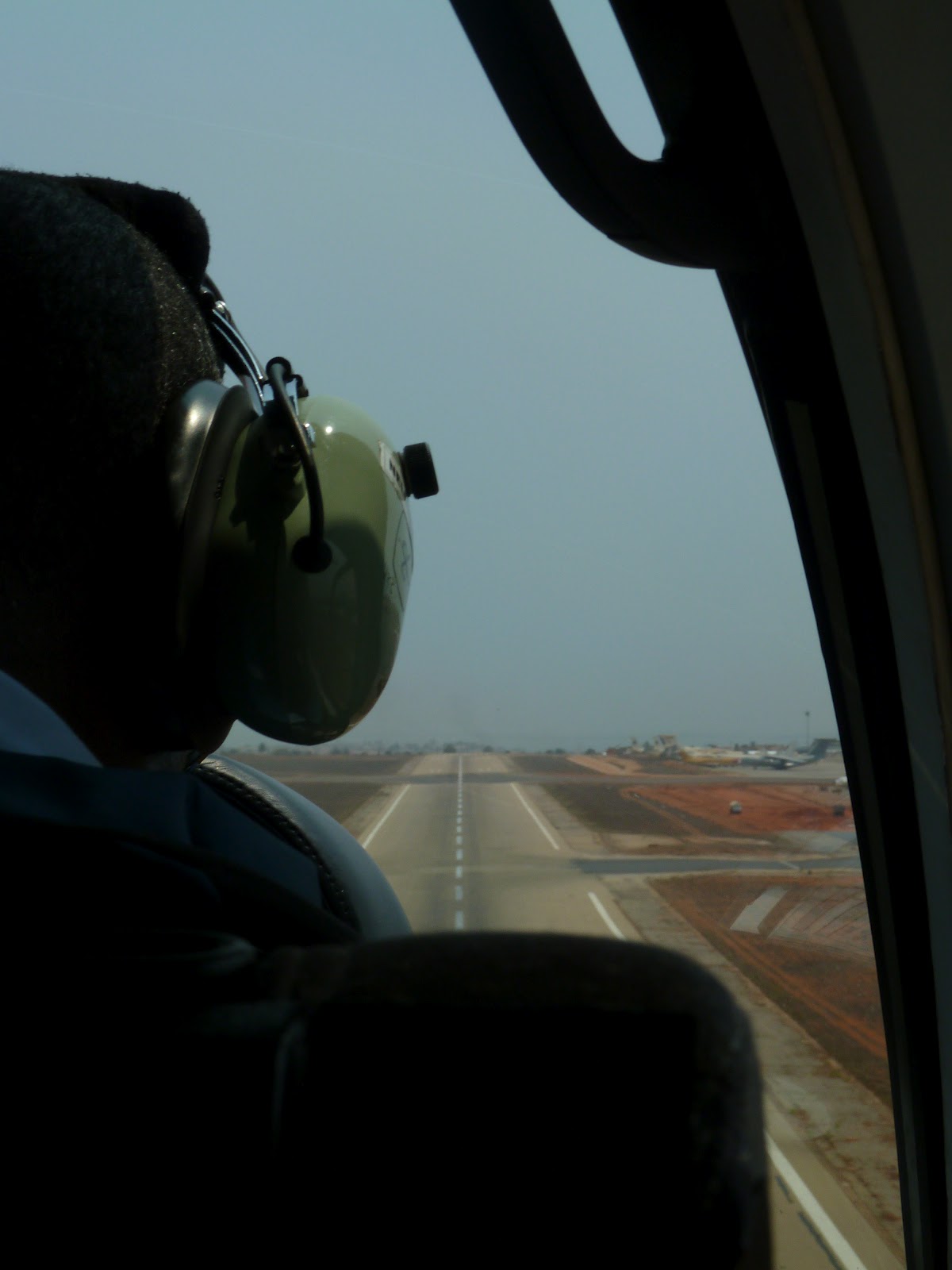
Finally after much fussing about with airports and stubborn bureaucracies it was finally time to head offshore to the inspection vessel 'Ocean Interceptor III' which would be our base of operations for all the servicing and data downloading we had to get done. This was particularly cool for two reasons: firstly, because we were finally able to start getting the work done that we'd gone all the way to Angola to do and secondly because I got to take my first ever trip in a helicopter! I must admit I was pretty nervous about it before taking off; not because of any fear of flying per se, but because before you're allowed to fly offshore with the oil industry you have to complete your 'Helicopter Underwater Escape Training' which involves being dunked repeatedly into a swimming pool in a fake helicopter and spun upside down a lot. So I was probably excessively concerned that that was a frequent way for helicopter flights to end.


A floating, semi-submersible rig.
The 'FPSO' ship, where all the oil gets pumped up to before being moved elsewhere for storage. 

Fortunately (obviously), we didn't crash into the sea. Even better than that, I'm also pretty sure that helicopter flights should be the default method of transportation for more or less much everything. It's an awesome way to travel, and was a brilliant way to get a different perspective on Luanda itself and the offshore oil fields.

Once we arrived on the rig, my two colleagues almost immediately set to servicing the modules so they could be recycled within the week and installed back in the DELOS platforms before we flew back to the mainland. I'm not an electrical engineer, so couldn't be much help without getting under their feet all the time, so I spent most of my time working through the data as it was downloaded. Happily it seems like all the technical issues we struggled with during the early deployments are now sorted out and I've got a decent set of data to work with, and plenty of fish to count!

Some fish spotted by the DELOS observatories

There wasn't a massive amount of wildlife out there, which isn't too surprising, but we did see a lot of fish which I wasn't expecting! I guess they were attracted to the ship, but we had large groups of jacks and yellowfin tuna (which are huuuuge!) circling the ship whenever we stopped as well as the odd shark! Manta rays made occasional appearances around the underwater platform structures which we got glimpses of from the ROVs, and we saw a good few groups of passing dolphins and whales as well (though nothing close enough to photograph).

Some of the deck crews working on the inspection ROV.

Finally, after a short week on the ship it was time to head back to shore again and then home. I'm still not entirely sure what to make of the trip overall - Angola is obviously benefiting greatly in some ways from the wealth it's gained from the offshore oil reserves, but the majority of people in the country are obviously still extremely poor. But as with anything, it's pretty difficult to make too many judgments on
a place you've only really experienced from the inside of hotels and taxis! It's probably easiest to let the photographs speak for themselves.

A street market taking place in a part of Luanda's sprawling residential area

One of Luanda's docks from the helicopter

Downtown Luanda