Showing posts with label marine. Show all posts

Saturday, 22 October 2016

The Florida Mullet Run

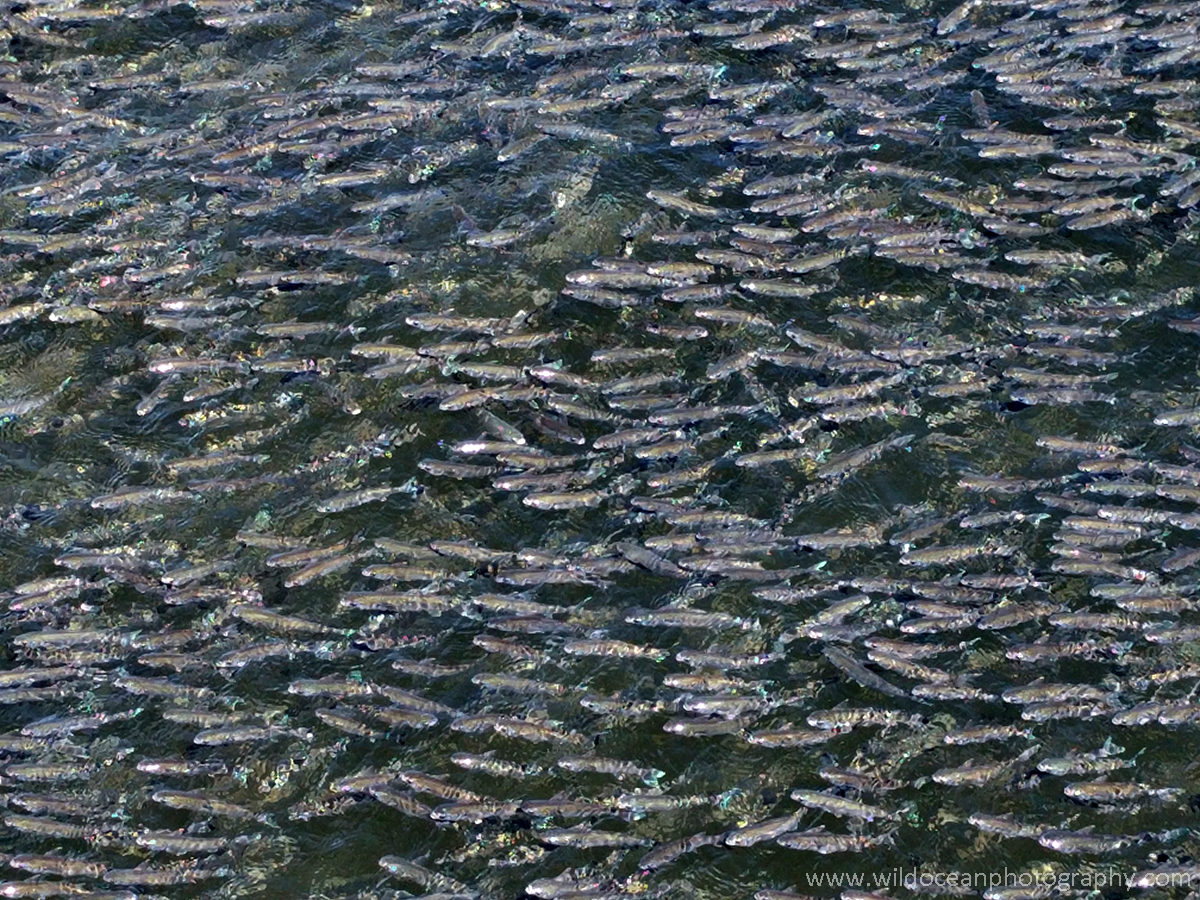
Every autumn a phenomenon called the 'Mullet Run' sweeps up the Florida coast, as millions of finger-size mullet head southwards along the Atlantic coast, following the warmer waters and their food supply of algae. It's quite a sight! As these small fish migrate, they form vast schools in order to avoid their predators, which in turn follow along to feed. If you've ever seen wildlife documentaries of the sardine run in South Africa, this is something similar.

Finger mullet in the harbour. The density of fish was this high everywhere!

Mullet being chased (and eaten) by jacks

This year's mullet run happened to pass my work last week. Overnight, the water in our boat dock became literally packed with mullet, as predatory jacks and pelicans chased them around the seawall at the entrance. Unfortunately, I only had my phone with me to take pictures with, but they at least give you a bit of an idea of just how many fish were all jammed in there together!


By the next day, I had my big camera in work with me, but it was all over and the majority of the fish had moved on (of course!). Hopefully next year!


Thursday, 25 June 2015

Whales!

Last night we were joined by a family group of pilot whales just as we were finishing dinner and preparing ourselves for our first night of seafloor sampling. Incidentally, running up and down two flights of stairs to get your camera after eating a large amount of lasagne and banana bread (separately, not at once!) is not an entirely pleasant experience!

A large pod of pilot whales popped by the ship yesterday.

Pilot whales in the waves

Pilot whales are funny beasts. They have a very lazy way of rolling through the water, which makes them a bit difficult to take interesting photographs of because they don't do much other than breathe and pootle about. The calves tend to be a lot more active and tend to leap around a bit more which is VERY cute to see if you can find a family group! 

Photobombing whale

Family of pilot whales

This pod had a couple of calves with them that still had visible foetal bands, meaning they must have been pretty new! We got really lucky with this group, and they stayed near the ship for about two hours. Most of the photos I took were of small black fins in the distance (as is typical of photographing whales and dolphins), but they did briefly come right up close to us and I got a few photos that were a bit more reasonable!


This pilot whale calf was so young the foetal bands were still visible on its flanks.

We've also been seeing a few shearwaters over the past couple of days. I'm not completely sure what species of they are, but I suspect they're Cory's shearwaters, though that's based mostly on the fact that I've seen them out here before and these ones look a bit similar. If anyone with a better internet connection than me can check and let me know it'd be much appreciated!

I think this is a Cory's Shearwater... Is that right?

Anyway, we've been put on night duty for our mud-coring work so I'm going to try and grab a couple of hours of sleep before dinner. See you next time!

Sunday, 12 April 2015

Multicoloured Harbour Crabs

When I was teaching at Millport a couple of weeks ago, one of the exercises we did involved conducting a short trawl in the Clyde so the students could see the technique and then get some experience in identifying and analysing the species present. What was interesting about these catches though is that one of them contained a rather unusual harbour crab (Liocarcinus depurator).

Trawling for animals in the Clyde Sea Area, from the Millport Marine Biological Station, Cumbrae.
Click for a larger image.

Harbour crabs are very common around the coasts of the UK, and are usually a fairly light orange-brown colour with purple patches on their swimmerets, a bit like this one:

A harbour crab (Liocarcinus depurator) showing the "normal" colour pattern.
Click for a larger image.

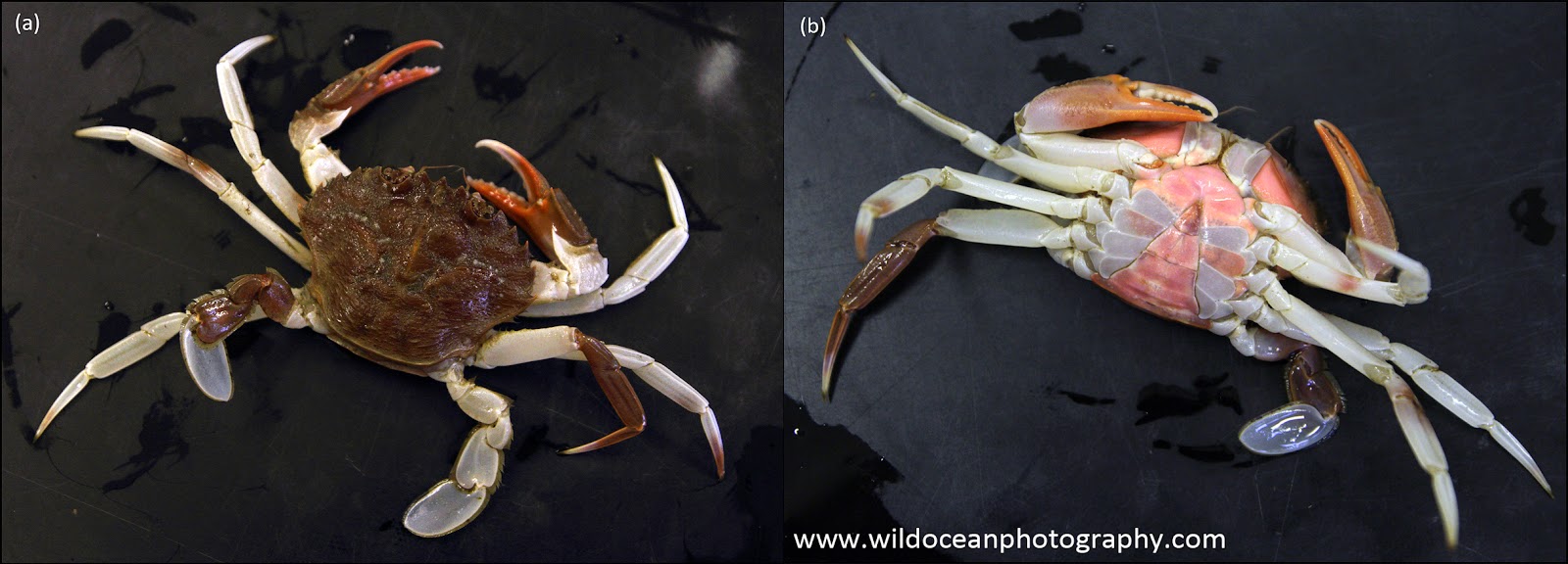
Unusually, the one we trawled up two weeks ago had a much darker body and completely white legs: 

An unusually-coloured harbour crab, caught by trawl in the Clyde Sea Area, just opposite the Millport Marine Biological Station, Cumbrae. I unfortunately lost my photos of the specimen, but Martina has kindly allowed me to use hers instead!

We keyed this guy out, and it appears to be Liocarcinus depurator, but a different colour morph. The REALLY cool thing though, is that this isn't the first time I've seen a crab like this. In 2010, a similarly-coloured crab was trawled up from the Clyde and brought to Glasgow University. I happened to have my camera with me, so was asked to photograph the specimen because it was cool and unusual, but I don't think we ever really followed it up. Anyway, the images were still sitting in my archives, and it turns out that they are rather similar (AND showed off its pink belly!): 

A similarly-strange harbour crab (Liocarcinus depurator) caught in the Clyde Sea Area in 2010.
Click for a larger image. 

I've had a bit of a look online for any reports of different colour-morphs in the Harbour Crab, but I haven't been able to find any previous reports of albinism or partial albinism in this species. A quick search pulls up plenty of examples of temperate crustaceans that have well-known colour variants, such as the red and green colour morphs of the common Shore Crab (Carcinus maenas), the Pacific shore crab (Hemigrapsus oregonensis), juveniles of the red rock crab (Cancer productus) and American (Homarus americanus) and Atlantic lobsters (Homarus gammarus) to name just a few.

Colouration patterns in crustaceans are driven largely by genetics (though environmental drivers can also be important in changing the brightness or colouration over shorter time-scales). It may be then, that the unusual harbour crabs we have caught from the Clyde have some mutation that gives rise to the different patterns. It would be interesting to know whether there are more crabs like this elsewhere in the UK, and what causes the change (unfortunately there's only so much you can tell from a photograph!). So, if you ever spot a harbour crab looking a bit like these ones, please let me know!

Friday, 29 March 2013

Friday of Interesting News: 29th March 2013

Sorry for the short break in news posts over the last couple of weeks, my life has become a bit of a rollercoaster with regards to the amount of work to do and time I have to do it in... However, we are back today with another week's worth of exciting news from the marine world. Do enjoy!

Wild Ocean Photography
It's been a busy wee week on the blog, with a new series of Dive Site guides started up and another new addition to the 'How to...' photography guide series:


The Deep Sea


Sea Beasts

Human Impacts & Sustainability


Other News

Saturday, 2 March 2013

Porpoises on the Clyde

I read somewhere once that owning a RIB was basically the same as owning a large fibreglass hole in the ocean into which you throw money. I will add time to that as well, since our boat is pretty old and therefore in constant need of some sort of repair and because I know nothing about RIB maintenance that I haven't learned through tortuous trial-and-error. Some days, owning a RIB is an utter pain in the ass.

But then you get days like today and it all feels worthwhile.

Trail Island in the Clyde.

Today I took four experienced divers out onto the Clyde to explore around Trail Island by Little Cumbrae since it's not a site we've dived much before with the University club even though it's virtually on our doorstep. Unfortunately, issues with a dodgy neck kept me out of the water myself, but whatever - I still got to take my RIB out for a spin, so who cares!

I couldn't really ask for much more out of a Saturday afternoon! 

Anyway, I dropped the guys in for a thoroughly relaxed and uneventful dive along the cliff-face and then left them to it while I just enjoyed being back at sea (and doing a spot of high-speed driving practice because frankly if you've got a boat to yourself with a 90HP engine on the back it would be rude not to!). A short 45 minutes later, the divers came back happy but cold and with plenty of decent site information we can add to our list for the Uni club so we decided to call it a day and head back home for some lunch. And that's when it all got rather exciting.

Just as we were reached the channel between the two Cumbraes, I spotted a couple of porpoise near where we'd seen some earlier in the day and slowed down to approach them. Porpoise are usually shy and solitary creatures so I wasn't holding out much hope of getting very close, but I slowly trundled us towards the area they seemed to be congregating in anyway and stopped the boat.

Porpoise!

Within a couple of minutes it was obvious that we hadn't just found a couple of porpoise, and even more obvious that we must have stumbled into a feeding spot because we were suddenly surrounded by about 20 of them, all swimming actively and (strangely enough for porpoise) happily circling the boat! I've worked as a wildlife guide before in one of the UK's porpoise hotspots, but I've never seen as many as there were today and never so close! By the time I remembered I'd brought my camera, they'd been with us for a good 10-15 minutes and were showing no signs of being disturbed by our presence which was just awesome. Photography was virtually impossible because the glare on water meant you couldn't see them below the surface to track when they'd appear, but I did manage to get this one shot. It doesn't do the event any justice at all, but at least you can see how close they were to us!

I reckon if every Saturday could be like this, I'd would never have anything to complain about :)

Friday, 4 January 2013

Friday of Interesting News: 4th Jan 2013

Happy New Year everybody and welcome to your first news roundup of 2013! As you might expect there are a lot of reviews of 2012 and 'best of -' lists kicking around on the internet at the moment, so here are a few of the better ones.

2012 Reviews
2012's most viral science videos
Top news stories from the London Natural History Museum
Animals that went extinct
Top 11 Ocean Stories of 2012
The top five posts from Deep-Sea News

Photography
TED-Ed: How Photography Connects Us
BBC's latest Attenborough Series 'Africa' started on Wednesday. Check out iPlayer if you missed it!

Marine Science News
Still looking for a New Year's Resolution? National Geographic has 10 for you!
Shell oil rig runs aground in Alaska
Record numbers of seal pups born in Norfolk this winter
Five organisms with real superpowers to rival their comic book counterparts
Deepest corals in the Great Barrier Reef discovered at 125m depth
Are jellyfish numbers really on the rise?
Poor weather washing Oceanic Sunfish ashore in the UK
Roman shipwreck reveals more secrets
Scott of the Antarctic may not deserve his bad reputation

Art & Design
Who wouldn't want one of these beautiful laser-cut wooden charts?
Ever wonder what a Narwhal really is? Ed Yong reveals all via twitter
Are your children not terrified enough of bathtime? Try these!
Must learn to knit one of these!
Enjoy!

Saturday, 29 December 2012

Saturday of Interesting News - 29th December

Ok, so I meant for this to go up every Friday, but yesterday I was in Fort William attempting to snowboard at the Nevis Range (sadly the weather had other plans...!) so I'm running a day late on the links. Better late than never though?

Here's the weekly roundup:

Photography
National Geographic photograph a shark eating another shark whole!
Not exactly marine, but BBC's new documentary series 'Africa' starts on Wednesday 2nd Jan.

Marine Biology

Design

Got any more news worth sharing? Send me an email at: info@wildoceanphotography.com

Friday, 23 November 2012

2013 Calendars: Last chance to pre-order

Each year for the last few years, I've put together a Wild Ocean Photography calendar for sale in time for Christmas, and this year is no exception. Unlike previous years though, next week I'm heading to New Zealand for a conference and a couple of weeks holiday so the deadline for pre-ordering calendars has been brought forward to this weekend. So if you're looking for a Scottish-wildlife themed Christmas present for the bargainous price of just £10 (+P&P) then you'd better get your orders in quick because I'll be placing the order with the printers on Sunday evening. There will be a few extras which you can pick up later if you miss the pre-ordering deadline, but there won't be many and once they're gone, they're gone!

The calendars are all A3 size and printed double-sided on high quality card with a silk finish. The proof copy looks really nice this year with the new design so I'm sure you'll not be disappointed!

For more information and to order yours, check out the calendars page on the WOP website at: http://www.wildoceanphotography.com/2013-calendars

The designs for this year are:

Cover
January
February
March
April
May
June
July
August
September 
October
November
December
Back cover

Saturday, 10 November 2012

Dahab and Red Sea Snorkelling

After what has probably been the busiest month ever, I am currently sat in the Open Ocean science centre in Dahab (Sinai peninsula, Egypt) where it is a bright and sunny 29C! Since people are starting to drop like flies with a dodgy stomach bug, I've got a bit of free time today (courtesy of sore feet and a lack of students though thankfully, not my stomach!) before we head down to the sea for some more surveying practice.

Anyway, the reason I'm all the way out here is because I'm assisting with Glasgow University's Tropical Marine Biology field course, which is run every year either in the Red Sea or occasionally in Tobago (Caribbean) if the political situation gets too bad in Egypt. The aim of the course is essentially to build on their coursework and give them experience of working in the field and conducting various types of underwater surveys while snorkeling. It's a course I did myself while I was an undergraduate at Glasgow Uni, although we went to Tobago instead. Overall, it's not changed too much, except that my identification skills are considerably rustier now than they once were and it's been as much of a crash course in Red Sea ID for me as it is for the students!

Still, the water out here is stunning and it's given me a chance to really try out my new Canon G12 & housing. It's challenging trying to get decent pictures while snorkeling compared to diving because it's so much harder to stay down and remain still for any length of time before you run out of air (I'm still very much an amateur when it comes to breath-hold diving!), but I've had a few successes! Before I disappear off again for the afternoon, here are a few that I've taken so far...

An anemonefish in its anemone


Crown squirrelfish

Humbug dascyllus

A porcupinefish hanging out under a reef 

A snorkeler heading back to the surface

I'm not sure when I'll get a chance to get back online for another update as we're heading to a new location tomorrow for a couple of days, then we're into the week of student projects so it might be pretty busy... I'll see what I can manage though and hopefully will get something up before I come back!


Tuesday, 18 September 2012

Field work in Angola: Part 1

So, after three weeks away to the west coast of Africa, I'm back to tell the tale! But before I launch into everything that we did out there, I'd better give you a bit of background on why we went.

Part of my PhD work is looking at the effects of deep-water oil production on the behaviour and composition of fish communities over time. While shalllow-water effects have now been studied in depth for a number of years, there is virtually no data available on the effects that oil production in the deep sea (>1000m) may have on the benthic (seabed) fauna, particularly on mobile species such as fish.

In shallow waters, oil rigs are known to provide artificial habitat for a variety of fish species, and the abundance of fish at such oil platforms can be far higher than in the surrounding waters. This knowledge has led to programmes such as 'Rigs-to-Reefs' in the US which convert decommissioned oil platforms into man-made reefs to provide artificial habitat for fish and invertebrates as well as protection from fishing activities such as trawling. Many shallow-water fish species are attracted to vertical structures and will use such open, complex structures to hide from predators or as feeding grounds once the reefs become colonised by invertebrate life. Even while they are operational, static platforms still provide hard substrate for invertebrates to live on and for mobile animals to live in and around.

Fish attracted to a decommissioned oil rig.
Image credit: http://www.guyharveymagazine.com/

However, the role of oil platforms in the deep-sea and their potential for providing artificial reef habitats are as yet unknown. While we might expect the effects to be similar in deep water as they are in shallow water we need to consider a couple of important differences in the behaviour of the fish themselves and the type of oil production structures present.

In the deep-sea, there is relatively little hard substrate; the majority of the seabed is comprised of soft sediments like muds and clays, and is typically rather featureless, particularly in the areas targeted for deep-water oil production fields. Consequently, we could expect the fish species that live in these areas to have relatively low affinity for hard substrates since natural reef structures are rare, and therefore that the presence of any reef structure would have relatively little effect on aggregating those species without some other attraction (e.g. a good food source).
 
Secondly, oil production structures in deep water are physically very different to those in shallow waters, and tend to be far more spread out over the seabed. The oil wells themselves are capped by wellheads which are a few metres in diameter, and which connect via pipelines to a central 'hub' which in turn connects a flexible pipeline to a floating surface production vessel. This means that the actual amount of 'reef space' provided by the structures is relatively low compared to shallow, static rigs and it is therefore unclear how much of an effect this might have on local fish populations.


An example of a deep-sea oil field with surface production vessels.
Image credit: http://angolarising.blogspot.co.uk/2011/11/big-oil.html


This is where I come in. As a part of my PhD, I'm using data collected by two seafloor observatory platforms situated off the west coast of Angola in 1400m of seawater and installed by BP through the DELOS project. One of the platforms sits around 50m from an active oil well (the 'Near Field' platform) while the other is located approximately 15km away from any production activity (the 'Far Field' platform) and acts as a control site. The platforms each contain a number of 'modules' which hold time-lapse cameras, environmental sensors, active and passive sonar sensors and a sediment trap at the far-field and we can use these to investigate how the environment varies naturally over time at each site and whether we can see any effects of either the oil production structures or natural environmental change on the fish communities present.

The DELOS platform frame (image from www.delos-project.org)

An ROV conducting an inspection of one of the DELOS platforms

We've been collecting data from these observatories since February 2009, and although there were some early teething problems which needed to be resolved, we've now got a very nice dataset covering three years from an area of the world about which very little is known about the marine environment at all, never mind the deep sea! However, while the platforms are designed to operate autonomously for the most part, they do need to be serviced each year for routine maintenance (swapping batteries etc.) and to download the data that's been collected over the previous 12 months. This all means that once a year, technicians from Oceanlab (University of Aberdeen) have to head south to the Angolan capital city of Luanda, and then offshore via helicopter to the ROV servicing vessel, work around the clock to get everything done in as short a time as possible, reinstall the modules into the observatories and head back home again with all the data.

Sounds pretty straightforward doesn't it?

Well, this year I was finally able to join the technical team and head down there myself to see the equipment that's been feeding me data for the last two years and learn how it all gets done! It wasn't quite as smooth sailing as we'd anticipated though...

Sunday, 5 August 2012

The Bass Rock Gannets

Yesterday me and a couple of friends headed over to the east coast of Scotland to visit the gannet colony on Bass Rock, and what an incredible experience it was! I'm not completely sure how to describe it all, because (as we were told at the start of the trip) the experience is pretty overwhelming but hopefully I try can do it some justice.

NOTE: As always, please click on the images to see them full size (and decent quality).

Looking for more tips on how to take the perfect shot? Check out my 'how to' guides for tips on photographing birds in flight, photography at sea and composing a great wildlife photograph.

Bass Rock
Image of Bass Rock as it was in 1690. From The Scotichronicon, 1867.

Bass Rock itself is a small, uninhabited island located off the south-east coast of Scotland in the Firth of Forth, protruding 120m above the surface of the sea and with a fascinating history. The island is a 'volcanic plug', which explains its steep slopes and distinctive appearance. Although it was historically used as an early Christian retreat (particularly by St. Baldred, a 6th century hermit), fortified with a castle by Lauder of the Bass (13th century), used as a crown prison (17th Century) and latterly, the site of a lighthouse (built in 1902 and unmanned since 1988), the island is now uninhabited by humans and instead has been completely taken over by gannets (Morus bassanus). With 150,000 individuals visiting the island every year to nest and breed, Bass Rock is the largest single colony of northern gannets found anywhere on Earth and has been described by David Attenborough himself as one of the 'wildlife wonders of the world'. Gannets are one of my favourite animals, and to say that I was excited about visiting the colony is a bit of an understatement!

The Bass Rock Gannets
I've been trying to get out to Bass Rock for about the last three years, but between the typical vagaries of Scottish weather and three busy summers of fieldwork it never worked out. Fortunately, this year was (finally) different and on Friday afternoon we got confirmation that our early-morning trip the next day was definitely going ahead. Of course, that's still no guarantee that it will be safe to land on Bass Rock itself, so there was always a possibility that we'd get out there and find out that we couldn't go ashore.

Bass Rock looming out of the fog

So on Saturday morning, we were up bright and early to meet our guide, Maggie Sheddan at 6.30am at Dunbar harbour and the boat (a local fishing boat, the Fisher Lassie) which would take us across to the island. The forecast for the day was good, but since the morning was about as foggy as I've ever seen, it was impossible to tell what conditions on the rock would be like. The journey out to the island took about an hour, and we could see virtually nothing except the occasional pieces of floating debris and fishing buoys looming out of the fog which made it all seem a little surreal! Eventually though, the steep volcanic cliffs loomed up ahead of us out of the fog and we were told it was safe to land! Hooray!

Every inch of free space is taken up by the gannets

Stepping off the little boat, everything about the island really hits you at once. The smell of hundreds of thousands of birds hits you eye-wateringly hard, while small groups of gannets, shags and gulls squawk all around you on the lower slopes and wheel overhead, and the walls of the ruined castle loom above you, with the stark white lighthouse towering up behind them and the sheer vertical seacliffs behind that. The paths leading up to the main part of the gannet colony are narrow, uneven and covered in bird faeces, fallen stones and marked with occasional carcasses of gannets which didn't survive the year. The path climbs steeply, passing through the overgrown castle ruins and finally out into the main gannet colony, where the noise rises to a cacophony of squeaks and squawks as the birds constantly remind each other (and us) of territorial boundaries. Combined with the constant blanket of swirling, thick fog it was a truly incredible experience!


Taking photographs on the way up the rock.

Fortunately, Maggie is obviously used to leading overwhelmed photographers around the colony and gave us a few minutes to just take it all in while she went to set up the paths we could use and our 'base' for the three hours we would be on the island, pointing out which individual birds we should avoid disturbing, and recommending that we just stop and watch the birds and their behaviours for a while. Even after spending just a few minutes watching them like this, it was immediately obvious that this was excellent advice and that we were in a wildlife photographer's heaven. Birds everywhere were performing their whole range of behaviours including their terrority-marking 'bowing' displays; 'beak-fencing' and 'sky pointing' were also being shown as part of the courtship displays between pairs, and the aggressive calling, lunging and pecking of animals that encroach too closely on another bird's territory was happening everywhere. On top of all of that, we'd obviously got the timing right for seeing the chicks at their fluffiest which was just too cute for words!

Our guide, Maggie, checking the gannets around our 'base'. The ground is effectively made of poo!

After a little while, we were led up the newly marked paths through a gauntlet of aggressively territorial parents (yes those beaks hurt about as much as you'd expect them to!) and up to a clear, flat patch with no nests where we could base ourselves and wander around to our heart's content. It's worth noting that the 'ground' was basically hardened bird poo though so it's not somewhere to wear your best clothes or bring food you need to eat with your hands!

It was kind of hard to concentrate with so much cuteness everywhere!

I'd gone on the trip prepared with a bit of a 'wish list' of photographs I hoped to take, which turned out to be a pretty good idea since half my brain refused to do anything useful for about an hour (it was stuck on 'wow!'). I'd read a lot of other trip reports where people were recommending 500mm lenses for portraits, but that length isn't really necessary (though I won't argue with the quality you get from the primes!) as we were able to be incredibly close to the gannets without disturbing them. Maggie explained that because they're territorial themselves, if you sit down quietly in one spot they'll simply assume that you've 'claimed' that space for yourself and will ignore you and behave completely normally.

Since I already have a lot of flight shots from the fishing boats and it was still foggy when we arrived, I started the day using my 300mm F4 IS for close-up portraits and detail shots which worked pretty well I think:

An adult gannet 'sky pointing' as part of its courtship ritual

A young chick appears from underneath its parent.

These are simply too cute for words.

An adult 'sky pointing'

I was also keen to get wide-angle shots of the colony, for which I used my 17-40mm F4 lens and the 70-200mm F4:


Balancing for a scratch

Getting in close with the wide angle lens

Using the 70-200mm to pick out individuals

Lastly, I wanted to try and get shots of the gannets coming in to land. This wasn't such a high priority since I already have a lot of in-flight shots from working on the fishing boats, but as the morning wore on, the fog began to lift a little and more and more of the birds starting taking flight. By about 11am, there was a constant stream of birds coming and going from the colony, and the ridiculous way they land was too good an opportunity to miss! It seems like they'll fly in so far, put the brakes on hard about a metre off the ground and then basically plummet into whatever happens to be underneath them. If they happen to crash in the wrong part of the colony they then have their own gauntlet to run past aggressive territory-holders! It was hilarious to watch and offered some great photo opportunities. For this set, I used my 70-200mm F4 to get a bit of flexibility in the zoom range and because they were moving far too fast and close for the 300mm.

Coming in to land. Hope there's space!

Putting the brakes on

Landing gear deployed!

Finally, after an incredibly short three hours it was time to leave again and we were taken back down to the Fisher Lassie. With the fog lifting a bit it was finally possible to see just how steep and wild the Bass Rock really is.

Bass Rock

On any other trip it would have been disappointing to have to leave the colony after what felt like such a short time, but we knew we still had another spectacle in store for us on the way back in. The boat took us a short distance out from the island, and began to 'chum' the water, throwing old fish out to bait the gannets in. We had been warned that this would be fast and furious, but that doesn't really do it justice! The gulls arrived first, and the first gannets started coming about 30 seconds later, making shallow dives into the water for the fish. A few minutes later and the sky was black with birds, all careening into the water and jostling for the fish (almost as much as we were jostling for spaces around the sides of the boat!). Most people (myself included at first!) adopted the 'spray and pray' approach to shooting the spectacle, because it is simply too hard to focus on what is happening in front of you. The display lasts longer than you expect it will (about 5 minutes) though, and as before, taking a few moments to watch the huge flock of feeding birds will help you make sense of the chaos and put together a photograph that works well. I started off with my wide angle lens to try and get a photograph that conveyed some sense of the sheer numbers of birds circling and diving around us, but I needed to stop and step back for a minute before I got anything worthwhile.
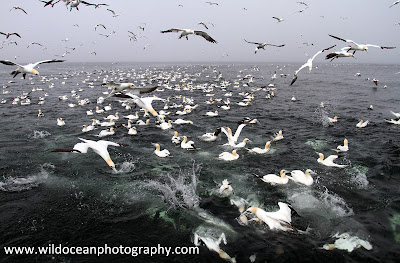
Feeding chaos around the boat!
I also wanted to try and separate individuals from the crowd, and for that I switched to my trusty 70-200mm lens (though I only used the wide end). Because the birds were making shallow dives from a low height, there wasn't much time to track them once they started diving so I found the best thing to do was to pick and track an individual in flight well before it indicated that it was going to dive. Sometimes they dived, sometimes they didn't, but there were more than enough opportunities to try again and I found this strategy worked really well (geeky science fact: this is also how predators cope when hunting 'grouped' animals e.g. lions vs. a herd of gazelle, hawks vs. flocks of prey birds, dophins vs. baitballs of sardines).

Banking round ready to dive

Gannet diving by the boat

Needless to say this final diving event was stunning. It felt like we were under a low ceiling the whole time and seeing that many gannets all flying, feeding, diving and swimming at once was a truly incredible experience, and I'm glad I took a pause from the camera to just watch it for a little while.

Finally after all that, we returned back to Dunbar harbour, exhausted, elated and covered in poo! It is not a trip for the faint-hearted, as the island is completely wild and there are no facilities, but it is so worth doing if you have any interest at all in wildlife. Finally, I would like to thank our exceptionally knowledgeable guide, Maggie for all her advice and information on getting the most out of our time on the island. It was an incredible experience and I hope I'll be able to get back there again next year!

For more gannet pictures from this trip and many others, check out my Gannets Gallery 

Getting There
Landing trips to the Bass Rock gannet colony are run exclusively by the Scottish Seabird Centre, and run through the summer months every year out of Dunbar Harbour. Depending on when you choose to visit, you can expect to see different behaviours from the birds, from pair-bonding rituals and nest-building at the start of the season, incubating eggs and young chicks through the middle of the summer and larger, nearly-fledged chicks by the end of the summer in August-September. I booked my trip for early August because I wanted the chance to photograph the chicks while they were still fluffy, but large enough to be easily seen, and I certainly wasn't disappointed! Of course, wildlife doesn't operate on strict schedules and even at this later stage of the summer we were still able to see all the typical adult behaviours.

Current tickets prices are £120 per adult (2015 prices) and you can choose between 7am or 1pm start times. You can also book online here.

My kit bag: