Showing posts with label Millport. Show all posts

Sunday, 12 April 2015

Multicoloured Harbour Crabs

When I was teaching at Millport a couple of weeks ago, one of the exercises we did involved conducting a short trawl in the Clyde so the students could see the technique and then get some experience in identifying and analysing the species present. What was interesting about these catches though is that one of them contained a rather unusual harbour crab (Liocarcinus depurator).

Trawling for animals in the Clyde Sea Area, from the Millport Marine Biological Station, Cumbrae.
Click for a larger image.

Harbour crabs are very common around the coasts of the UK, and are usually a fairly light orange-brown colour with purple patches on their swimmerets, a bit like this one:

A harbour crab (Liocarcinus depurator) showing the "normal" colour pattern.
Click for a larger image.

Unusually, the one we trawled up two weeks ago had a much darker body and completely white legs: 

An unusually-coloured harbour crab, caught by trawl in the Clyde Sea Area, just opposite the Millport Marine Biological Station, Cumbrae. I unfortunately lost my photos of the specimen, but Martina has kindly allowed me to use hers instead!

We keyed this guy out, and it appears to be Liocarcinus depurator, but a different colour morph. The REALLY cool thing though, is that this isn't the first time I've seen a crab like this. In 2010, a similarly-coloured crab was trawled up from the Clyde and brought to Glasgow University. I happened to have my camera with me, so was asked to photograph the specimen because it was cool and unusual, but I don't think we ever really followed it up. Anyway, the images were still sitting in my archives, and it turns out that they are rather similar (AND showed off its pink belly!): 
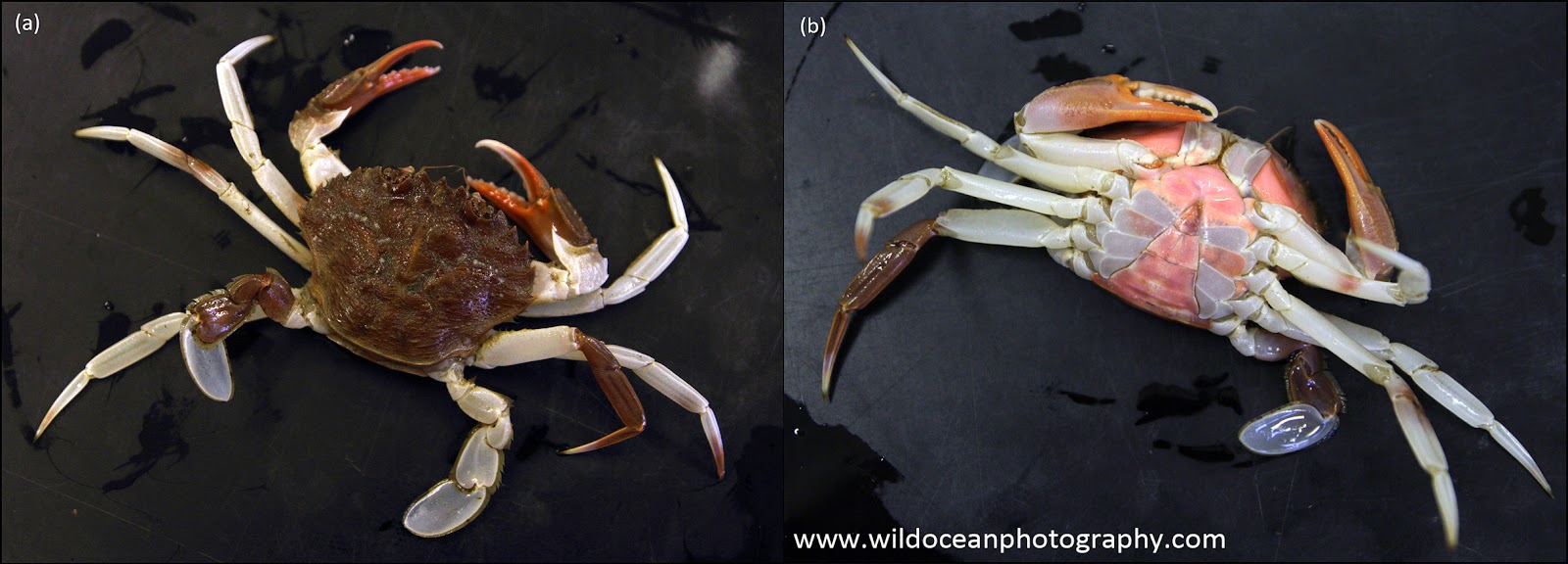
A similarly-strange harbour crab (Liocarcinus depurator) caught in the Clyde Sea Area in 2010.
Click for a larger image. 

I've had a bit of a look online for any reports of different colour-morphs in the Harbour Crab, but I haven't been able to find any previous reports of albinism or partial albinism in this species. A quick search pulls up plenty of examples of temperate crustaceans that have well-known colour variants, such as the red and green colour morphs of the common Shore Crab (Carcinus maenas), the Pacific shore crab (Hemigrapsus oregonensis), juveniles of the red rock crab (Cancer productus) and American (Homarus americanus) and Atlantic lobsters (Homarus gammarus) to name just a few.

Colouration patterns in crustaceans are driven largely by genetics (though environmental drivers can also be important in changing the brightness or colouration over shorter time-scales). It may be then, that the unusual harbour crabs we have caught from the Clyde have some mutation that gives rise to the different patterns. It would be interesting to know whether there are more crabs like this elsewhere in the UK, and what causes the change (unfortunately there's only so much you can tell from a photograph!). So, if you ever spot a harbour crab looking a bit like these ones, please let me know!

Sunday, 22 March 2015

Straight from the (Sea)Horse's Mouth: Student Blogs from Millport

I posted a short blog this morning about the Marine Biology field trip that I was teaching on last week, but I didn't give much detail about what the students were actually learning, because I thought it would be much more interesting to hear it from them.

Such enthusiasm!
Over the course of the week, the students kept group blogs about what they were up to and any cool observations they made during the week. There are 14 of them in total, and there are new posts going up all the time now that we're back in the land of working internet access, and you can find them all at:

www.mfestudentblogX.wordpress.com

Just replace the "X" in the url with any number between 1 and 14 (e.g. www.mfestudentblog1.wordpress.com) and you should find yourself reading about some interesting coastal science!

Be warned though, there are a LOT of puns!


Back where it all started: Marine Biology at the Millport Marine Station

All the way back in 2001 I started my undergraduate degree in Aquatic Bioscience (I know, it's fancy!) at Glasgow University. I had gone to uni specifically to study marine and freshwater ecology, but because the first two years of the (four-year) degree focussed on a broad range of general biology subjects, it was only in 3rd year that we got to start studying anything related to marine ecology. It was a long time coming, but it was awesome to get started and our field trip to the Millport Marine Biology station (on the Island of Cumbrae) was a big part of that. It involved a stupid amount of work, but we were learning real marine ecology in the field for the first time, and that was pretty awesome. So, when I was asked if I wanted to go back this year as one of the course tutors, it was a pretty easy decision to make!

Sandy shore surveys at Kames  Bay. Click for larger version.

So last Saturday, I headed down to Cumbrae with 5 other staff, ready to teach 73 undergraduates about coastal ecology. To say the schedule was packed is a bit of an understatement, with the course content covering rocky & sandy shore surveys, plankton surveys, trawl surveys, microbiology labs, mark-recapture experiments and foraging observations on oystercatchers over a mere 6 days! On top of all that, they also had to keep daily group blogs (which was admittedly tricky without a good internet connection) and produce a short video describing a scientific paper in a creative and entertaining way, while also making time for lectures, briefings, cake and alcohol. Despite all that, the level of enthusiasm and excitement the students brought to the work made the entire course so easy to teach it was awesome.

We did a LOT of science this week. Click for a larger image.

After 12 years in research studying the macrofauna living in deep-water corals, parasites in Icelandic cod, the langoustine trawl fisheries along the west coast of Scotland, and human impacts on deep-sea fish communities (and all the stress of a PhD when things are going badly), coming back to this course was a really cool reminder of why I started out on this career path in the first place. And that is to say nothing about the awesome folk I've studied with, worked with and been cruise buddies with! It's been a long and slightly random journey at times to reach this point, but I wouldn't change a thing.


Tuesday, 3 March 2015

Great Cumbrae & Millport (Firth of Clyde)

The island of Great Cumbrae sits in the Firth of Clyde, approximately a 10 minute ferry ride from the seaside resort town of Largs on the mainland. Considering it is only about a 40-minute drive from Glasgow and given the proximity of large towns and ferry ports such as Greenock, Gourock and Ardrossan (not to mention Hunterston power stations!), a great part of the island's charm is that it still manages to feel as though it's miles away in the heart of the Scottish countryside. In addition, the island and its surrounding waters are a great place to see a huge variety of coastal marine wildlife from seabirds to seals.
Location of Great Cumbrae in the Firth of Clyde

Millport & the South of the Island

Students working on Kames Bay


In the town of Millport are two large sandy bays (Kames bay and Fintry Bay) which are popular spots for dog walkers and horse riders, which doesn't always make them most peaceful spots for wildlife watching. But, if it's quiet, it can be a decent place to look for waders and you'll get some beautiful views south towards Ailsa Craig if the weather's nice. From the harbour you can also get some cool views of the seal colony if you have your binoculars with you (or a long lens).

Rocky pools along the coast are great places to play around with your camera and find some cool marine life in the process!

Rocky beaches dominate the rest of the coast which are brilliant for rockpooling (particularly at White Bay in the north of the island).

Blue-rayed limpets can be found on the underside of kelp fronds if you look at low tide.

The marine life here is quite typical for a Scottish rocky shore, and all the usual species of green and brown seaweeds, limpets, barnacles, winkles, mussels and beadlet anemones can be found readily in the pools. Blue-rayed limpets are also commonly found on Kelp fronds in the sublittoral zone (only accessible at low tide). If you have a net and fancy a bit of pool-dipping, you can also often small crustaceans (e.g. shrimp and amphipods) and occasionally small fish in many of the rockpools here. There is an easy circular path around Farland point which makes it suitable for most people, though it can get a bit muddy.

Coastal birds and Seabirds

There are a huge variety of coastal birds and seabirds around Great Cumbrae, which a quick trip around the island will prove! Eider ducks are common around the entire coast, and can regularly be seen diving for food, or calling to each other in large groups, though I've never been particularly successful at approaching them on the island. For that, I tend to find that fishing harbours are a better place to photograph them, but you never know your luck.

A curlew on the shore.
Bar-tailed godwits foraging on the shore.
Oystercatchers on Cumbrae.


Oystercatchers and curlews are also extremely common, and can often be seen in large groups, either resting or feeding at the beaches, along with shags and cormorants, lapwings, and various waders such as turnstones, dunlin and redshanks.

Gulls on the shore.
A cormorant in flight.

I have generally seen these species most often along the western side of the island and the bays in the north, although I would expect them to be seen around most of the coast. In the north and north-west of the island there are also several Swan (or Chinese) geese, which are a domestic species and are not native to Scotland. Around the town of Millport itself, it is not uncommon to spot red-breasted mergansers, as well as all the usual gulls you would expect to find in a seaside town!

Gannets can be commonly seen out in the Clyde channel.

Several species of seabird also live on the island, including a small colony of Fulmars which live on the cliffs in the south of the island. Kittiwakes and gannets can also commonly be seen further out at sea. There is a large gannet colony at Ailsa Craig, south of the Firth of Clyde, and the waters around Millport are a popular feeding area for these birds in the summer (particularly when the fishing boats are working).

Marine Mammals and Basking Sharks


Porpoise feeding between the islands of Great and Little Cumbrae.
The Firth of Clyde is home to a large number of marine mammals, including large groups of harbour porpoise, common dolphins and common dolphins. Minke whales can also be seen in this area. In the past, there have also been sightings of Killer whales (Orca), a Risso's Dophin, and even a humpback whale! Sightings of these species are incredibly rare however, and are certainly the exception rather than the norm. Nonetheless, taking a pair of binoculars out to the coast with you could certainly be worthwhile. 

Grey seals hauled out opposite Millport harbour.
Around the coast of Great Cumbrae, it is quite common to spot common and grey seals. There's a small haul-out area for grey seals just opposite the main harbour in Millport, and if you have a pair of binoculars you should be able to spot them there quite easily.

The waters around Great Cumbrae are famous for basking sharks, not least because this was until very recently, the home of the last basking shark fishery in the UK. In 2005, the Firth of Clyde had the second highest sightings rate for basking sharks in Scotland (after the Minches).
To see more photographs like the ones in this article, have a look at the Seabirds, Coastal Wildlife and Marine Mammals galleries.