Showing posts with label scotland. Show all posts

Tuesday, 23 June 2015

To the Abyss (again!)

It's nice to be back at sea!
 
Last Friday, I left Glasgow with one of my fish-ecologist colleagues to join the RRS Discovery for another cruise to the Porcupine Abyssal Plain (PAP) long-term survey site. This is my fourth trip out to the PAP in as many years now, and I must admit it's really nice to be back on a ship! 

Me and Jo, ready to sail!

Leaving a wet and rainy Liverpool

The main purpose of this particular cruise is to service the PAP monitoring buoy and download the data that it's been collecting for the past year. This includes oceanographic data (e.g. current speed, water temperature, salinity), as well as collections of the sinking particles of dead organisms, biological waste and other organic and inorganic materials that make up the "marine snow" which fuels the vast majority of deep-sea ecosystems.

The Porcupine Abyssal Plain (PAP) study site is about 300 miles south-west of Ireland

Recoving the PAP buoy in 2013

Taking a ship 300 miles offshore is not a simple (or cheap!) task however, and there's no point coming all the way out here just to service a buoy and go home again so we've got a full contingent of scientists ready to make the most of the opportunity to collect their own data from the PAP site. On this particular cruise, we've got teams who are interested in understanding how mid-water bacterial processes and communities are influenced by "marine snow" particles, as well as researchers who will be studying the plankton communities and oceanography of the site. We even have a couple of holographic cameras which can automatically assess the sizes of all the particles in a tiny patch of seawater and rebuild an image of them all! 

Some photos from the last time I was out here to fish in the abyss. Hopefully this time we'll catch even more!
 
As exciting as the midwater research is though, I am here with Jo Clarke from Glasgow University to go fishing! We're working with the "benthic" (seafloor) ecologists from NOC to help collect deep-water animals from the seabed using mud cores, grabs and a trawl. We're really here for the fish, so we're mainly interested in the fish samples, and are here to make sure that they get identified, processed and recorded correctly for any future work that might be done on them. We'll also be helping out with all the other benthic sampling that needs to be done which will largely involve dealing with a lot of mud!

Sieving mud samples isn't so bad really!

The megacorer is one of the standard sampling gears for getting good quality sediment and animal samples back from the seabed. We'll be seeing a lot of it over the next few days!


So far we've had a pretty quiet start to the cruise. We met the ship in Liverpool and then spent a couple of days steaming south to Falmouth so some repairs could be done to one of the ship's thrusters while we were still near the coast. Happily that all went well, and we reached Falmouth just after midnight on Sunday for a mini crew-swap before starting our voyage to the PAP site. We should arrive there tomorrow, ready to start working!

Sunday, 14 June 2015

North Queensferry / Carlingnose Reserve

The Forth Rail (and road) bridge at North Queensferry, as seen from Carlingnose Reserve.

North Queensferry is probably best known for their stunning views of the Forth Rail Bridge, and possibly for the Deep Sea World aquarium (if you haven't been, it's VERY cool!) However, the Scottish Wildlife Trust also run a lovely little reserve at Carlingnose Point with views looking west over the Firth of Forth.  ... If you can find it that is!

North Queensferry (link to map)

We parked at a car park underneath the rail bridge, found a sign showing that we were not only in the right place, but a mere stone's throw away from the reserve. It then took us about an hour of wandering the town and scrambling unnecessarily over the boulder shore before we admitted defeat, went back to town and managed to find the path leading to it.

There was a lot of really interesting dried out pieces of driftwood along the shore.

Top tip: if you ever arrive looking for the reserve yourself, there are no signs in the town, but you'll find it if you follow the signs for the Fife Coastal Path and head away from the town (or away from the grey road bridge if that's easier).

Look for the Fife Coastal Path and follow it west. There are no signs for the Carlingnose Point Reserve in town that I could find. 

The reserve itself is in place to protect locally rare populations of wildflowers and plants, and the dense scrub provides a nice habitat for smaller birds as well but it's also a nice viewpoint to look for seabirds on the shore. We visited in May and only saw a couple of eider ducks, but it was a really sunny day and it's possible that the birds had all finished foraging early in the morning and headed away to roost by the time we arrived.

The reserve was small and pretty quiet on the day we visited, but the vast fields of gorse were stunning!

There's an old ruined pier just offshore that had a sleeping gull on it, but the wildlife was keeping fairly quiet on the day we visited.

An old ruined pier lies just offshore off the reserve.

Sunny afternoons are perfect for napping, no matter what species you are!

The reserve itself is pretty small, but if you follow the Fife Coastal Path, you'll be led down to a big sandy bay where you get some lovely views over the Firth of Forth.

Following the coastal path brings you to this beach which was covered in oyster shells.
A group of cormorants were out enjoying the sun on the edge of the shore too.

The beach was also covered in oyster shells, which is pretty unusual and the first time I can remember seeing any - especially in such large numbers!

Shells from what I think might be native oysters (Ostrea edulis). I included a 10 pence coin for scale, which has a diameter of roughly 25 mm.  

I suspect they're possibly native oysters (Ostrea edulis), but I'm not an expert on these animals. If anyone knows what these are, it'd be really interesting to know.

North Queensferry and the road and rail bridges over the Firth of Forth.

Back in the town, you will of course be treated to some stunning views of the road and rail bridges, but the town itself is beautiful and quite typical of a coastal Fife town so it's well worth saving a little time to look around the town and its harbour before you leave. It's sometimes also possible to see dolphins in the tidal races underneath the rail bridge, so they're worth looking out for too!

The new road bridge being constructed. 

This year (2015), they're also in the process of building a new bridge over the river and it's pretty cool just to see the scale of the engineering works that are happening just now.


Tuesday, 19 May 2015

Seaton Cliffs

A couple of weeks ago, I headed up to the red sandstone coastline of the Scottish Wildlife Trust's Seaton Cliffs wildlife reserve. The reserve sits on the east coast of Scotland, just at the town of Arbroath. That's not a million miles away from the big seabird colonies at the Isle of May, Bass Rock and the Farne Islands and I was keen to see if there were any seabirds nesting along the cliffs since it would certainly be an easier (and cheaper) spot to get to than the islands of a weekend!

Wildflowers on the Seaton Cliffs with Arbroath in the distance.

Seaton Cliffs Wildlife Reserve. Link to Google Maps.

Almost as soon as we arrived at the reserve I realised that I'd left the battery for my DSLR in the charger at home which was... less than ideal! This led to the subsequent realisation that there is nowhere obvious in Arbroath to buy a battery for a Canon 7D. Fortunately, I had my trusty Canon G12 tucked away in my rucksack as well though, which turned out to be absolutely fine for the wildflowers and lovely scenery.

The red sandstone Seaton Cliffs.

A couple of snoozing gulls was the only bird life we saw on the cliffs for the first half an hour or so. We did walk VERY slowly though! 

Sauntering along the path from the car park in Arbroath, we were treated to lovely views of the cliffs and views over the North Sea, but not much in the way of birds. There were plenty of wildflowers though and lots of little white butterflies in amongst them which were lovely (but too skittish for my compact camera), as well as skylarks in the fields on the other side of the path.

A sandstone arch carved out by the sea.

My old dog certainly enjoyed the walk!

The cliffs themselves have been weathered into all kinds of shapes and structures, and it looked like an outdoor-adventure group were setting up ropes along some areas, presumably for a spot of cliff-walking or something similar. The walk was also clearly popular with dog-owners, so if you're looking for a more solitary experience, this might not be the place for you! Then again, it was also a beautifully sunny day when I visited which might have boosted the numbers a bit.

Kittiwakes and gulls nesting on Seaton cliffs. A couple of guillemots and shags were also present on the rocks by the shore, but may just have been passing through.

A northern fulmar (Fulmaris glacialis) on the cliffs.

Eventually, we did find a small bay which had quite a few kittiwakes, gulls and fulmars nesting on them, as well as a couple of guillemots and shags further down by the water. It wasn't a huge number of birds, but the cliffs were obviously protected enough from predators and the elements that it was good enough for some at least! If you're just looking for a few birds, this was a nice wee spot to see them, but it was nothing like as crowded with animals as the big island colonies, and there were definitely no puffins.

Cormorants, eider ducks and oystercatchers were happy to hang out in the bay next to the car park.

By the time we got back to the car, the tide had come in and there were a few more birds hanging out on the rocks just opposite the car park including a few cormorants, eider ducks and oystercatchers which was pretty cool. Later in the season it might be worth swinging by to have a look out for eider ducklings!


Tuesday, 28 April 2015

My Best Friend's Wedding

This weekend I got the chance to do something a little different (for me anyway), and swap my wildlife subjects for wedding guests! Michelle (who's been my best friend for a very long time!) got married to her husband Steven in Mauritius last year, which is a rather lovely venue for a wedding, but one that not many of us were able to get to. Since I was deeply mired in the horrors of thesis writing at that point, I was one of the people who couldn't make it along.

Not everyone was quite so engrossed in the ceremony! (Photo by Kevin Boyle).

Waiting to cut the (rather delicious) cake

The bride's speech

Fortunately part two of the wedding celebrations was planned for last weekend at Dalduff Farm in Ayrshire which was much closer to home! Since I knew that they weren't planning to have a photographer at this celebration, I offered to bring my kit with me on the understanding that this was my first shot at photographing an actual wedding and there were no guarantees of success!

Michelle and Steven, the lovely bride and groom!

And the lovely bridesmaids!

Happily, we got a stunningly beautiful day for it all, and the photos turned out pretty well I think. It was also a lot easier and a lot more fun than I was expecting it to be, but I guess it helps when you know half the room!

Every wedding should end with a ceilidh. Always.

So there we go - my first wedding as a photographer (sort-of)! Congratulations again to Michelle and Steven, and I promise I'll be back to the wildlife updates and wellies with the next blog! 

Sunday, 12 April 2015

Multicoloured Harbour Crabs

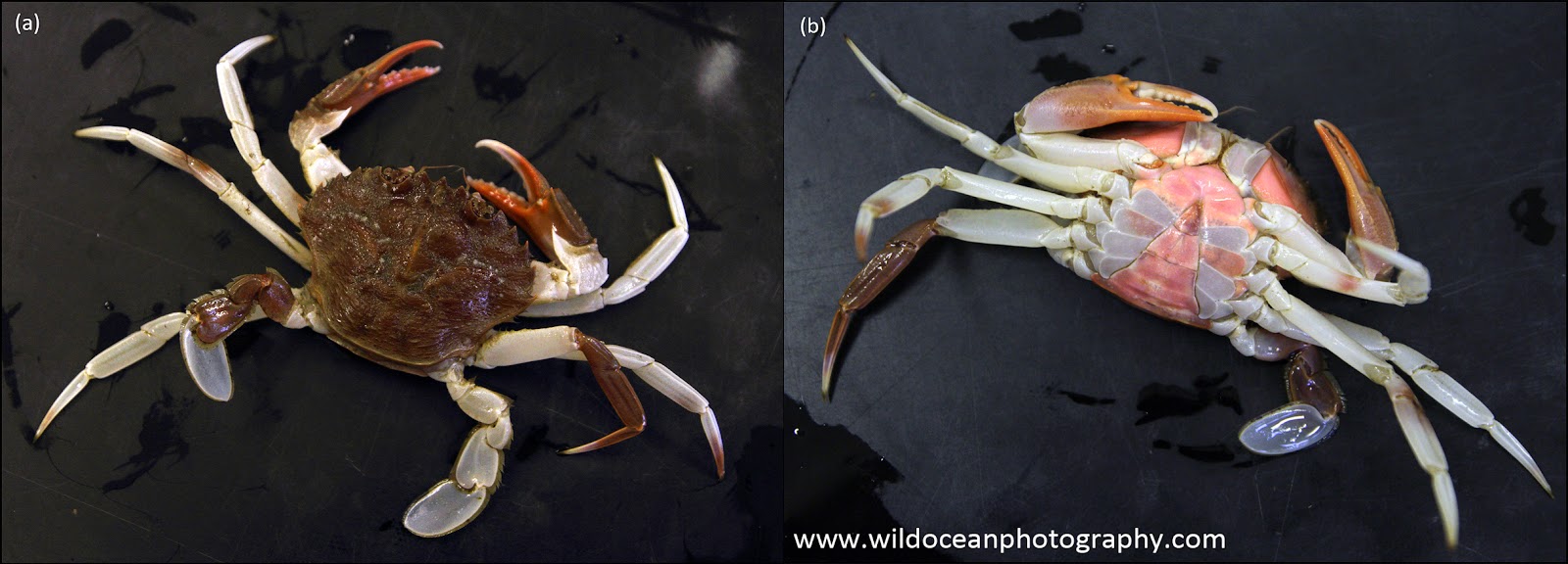
When I was teaching at Millport a couple of weeks ago, one of the exercises we did involved conducting a short trawl in the Clyde so the students could see the technique and then get some experience in identifying and analysing the species present. What was interesting about these catches though is that one of them contained a rather unusual harbour crab (Liocarcinus depurator).

Trawling for animals in the Clyde Sea Area, from the Millport Marine Biological Station, Cumbrae.
Click for a larger image.

Harbour crabs are very common around the coasts of the UK, and are usually a fairly light orange-brown colour with purple patches on their swimmerets, a bit like this one:

A harbour crab (Liocarcinus depurator) showing the "normal" colour pattern.
Click for a larger image.

Unusually, the one we trawled up two weeks ago had a much darker body and completely white legs: 

An unusually-coloured harbour crab, caught by trawl in the Clyde Sea Area, just opposite the Millport Marine Biological Station, Cumbrae. I unfortunately lost my photos of the specimen, but Martina has kindly allowed me to use hers instead!

We keyed this guy out, and it appears to be Liocarcinus depurator, but a different colour morph. The REALLY cool thing though, is that this isn't the first time I've seen a crab like this. In 2010, a similarly-coloured crab was trawled up from the Clyde and brought to Glasgow University. I happened to have my camera with me, so was asked to photograph the specimen because it was cool and unusual, but I don't think we ever really followed it up. Anyway, the images were still sitting in my archives, and it turns out that they are rather similar (AND showed off its pink belly!): 

A similarly-strange harbour crab (Liocarcinus depurator) caught in the Clyde Sea Area in 2010.
Click for a larger image. 

I've had a bit of a look online for any reports of different colour-morphs in the Harbour Crab, but I haven't been able to find any previous reports of albinism or partial albinism in this species. A quick search pulls up plenty of examples of temperate crustaceans that have well-known colour variants, such as the red and green colour morphs of the common Shore Crab (Carcinus maenas), the Pacific shore crab (Hemigrapsus oregonensis), juveniles of the red rock crab (Cancer productus) and American (Homarus americanus) and Atlantic lobsters (Homarus gammarus) to name just a few.

Colouration patterns in crustaceans are driven largely by genetics (though environmental drivers can also be important in changing the brightness or colouration over shorter time-scales). It may be then, that the unusual harbour crabs we have caught from the Clyde have some mutation that gives rise to the different patterns. It would be interesting to know whether there are more crabs like this elsewhere in the UK, and what causes the change (unfortunately there's only so much you can tell from a photograph!). So, if you ever spot a harbour crab looking a bit like these ones, please let me know!

Tuesday, 7 April 2015

Foggy day in Tentsmuir National Nature Reserve

I'm not going to lie, yesterday's trip to the Tentsmuir National Nature Reserve (NNR) wasn't exactly the most successful photographic outing I've ever been on! On what was otherwise a beautifully hot and sunny Easter Monday for the vast majority of the UK, it would appear that the North Sea had other ideas...

The forest edge shrouded in fog was cool and slightly eerie!
Click for a larger version.

By the time I got to the Firth of Tay, it was clear that the North Sea was producing one of its characteristic haars. But, it was fairly light cloud and so I figured it would burn off soon enough as the sun got stronger through the afternoon. The NNR isn't very well signposted from the road so it did take a while to find the place, but I eventually arrived at Tentsmuir Forest (there's a £2 car park fee if you're planning on visiting).

British beach holidays are traditionally a slightly grim affair.
Click for a larger version.

The fog was far thicker by the coast, and gave the forest edge a cool, "Game of Thrones" type atmosphere. I still thought it would probably dissipate pretty quickly though, so I set off, following another intrepid British family who were obviously not going to let some inconvenient weather ruin their bank holiday at the beach.

A pool near the edge of Tayport Heath NNR. I'm sure the North Sea was behind it somewhere...
Click for a larger version.

I headed north into the haar and walked up the sandy coast for about 3 miles.

Still foggy! It was pretty cool though.
Click for a larger version.

The fog didn't burn off.

Ringed plovers scooted by a couple of times while they were foraging at the top of the shore.
Click for a larger version.
I THINK that this might be a skylark. Can anyone confirm the ID for me?

As you might expect, I didn't see too much in the way of wildlife! A couple of ringed plovers dashed by as they foraged along the strandline, and there were small birds darting around the dunes that I think might have been skylarks. If anyone can confirm the ID from the photo above, it would be much appreciated!

The weather was lovely 200 m from the shore!

After I gave up on the coast, I walked the 2 miles back to my car through the forest. It turned out that the fog only extended about 200 m inshore though before giving way to beautiful sunshine... I tried not to take it personally! Still, although there were tons of songbirds in the trees the forest itself was a little too full of holidaymakers to really offer many photographic opportunities.

Despite the unlucky weather, the reserve was a lovely place to spend a day and isn't that far from Glasgow for a trip out. The information spots promised that the beaches are good seal haul-outs (for grey and harbour seals) and are good places to see flocks of wading birds and eider ducks. Maybe next time!

Monday, 30 March 2015

The Marine Biology of Rocky Shores

So after two busy weeks of tutoring at the Millport Marine Station, I've made it back to Glasgow where there's a decently-working internet connection and I can finally share some of the photos from the trip!

The coast at Farland Point. This is a classic example of an exposed rocky shore and is frequently surveyed by visiting student groups! Click for a larger version.
Over the past week, I've been helping a couple of groups of MSc students do some short fieldwork projects to get them used to the trials and tribulations of trying to do good scientific research in real, coastal ecosystems (which very rarely behave the way you think they will!). Because their work involved gathering lots of samples from the local rocky shore at Farland Point (just a convenient 5 minute walk from the Marine Station), it gave me some time to collect some nice photographs of the marine life while the students were working. The plan I have is to eventually collate these images into short photographic identification guides or posters for different plant and animal groups (which will be freely available online), but that will probably require a bit of work to sort out! In the meantime, keep an eye on the Marine Identification galleries for updates, and enjoy this very brief guide to a typical Scottish rocky shore!

The Subtidal Zone

Extremely low tides expose the kelp beds in the Subtidal Zone, which are usually covered by the sea. Click for a larger version.

With each equinox come big tides, and this week we got some great low tides and access to the subtidal zone (the part of the beach that is normally completely covered by water), which is great for exploring. This part of the beach is home to large, brown (and edible!) kelp species, which in turn are home to some surprisingly beautiful animals like the blue-rayed limpet which lives on the underside of the fronds. If you're lucky, you might also find some fully marine organisms down here that have been temporarily exposed by the tides.

Blue-rayed limpets are often found attached to the underside of kelp fronds in the subtidal zone and are incredibly pretty. It is believed that the blue colours are used to mimic (toxic) sea slugs which keep potential predators away. Click for a larger version.

Urchins, starfish and other fully marine organisms can sometimes be found during extreme low tides. Click for a larger version.

The Eulittoral Zone

Juvenile mussels may be common on the lower shore.  Click for a larger version.

Moving further up the shore into the "eulittoral" or mid-shore, we start to find more of the familiar rocky-shore species. Everything that lives here will spend some part of each day exposed to the air between tides, so everything has to be able to cope with increasingly long periods of dessication, temperature fluctuations and fresh water until the tide comes back in. As a result, shelled animals like winkles, limpets, dogwhelks and sometimes topshells are particularly common, since they can use the shells to seal themselves away when conditions get tough. The most common species here tend to be the wracks (brown algae), barnacles or mussels, all of which compete with each other for the limited amount of space available. Whichever ones are found in the greatest numbers on your particular shore will depend largely on the local environmental characteristics.

Dogwhelks are common on rocky shores and lay eggs shaped a bit like milk bottles (or popcorn kernels) in cracks in the rocks.  Click for a larger version.

Topshells are characteristically striped (but may occur in all kinds of colours) and are some of the prettiest snails you'll find on the beach. Click for a larger version.

The Upper Shore

Common lichens of the supra-littoral (splash zone). I believe these are: (a) Tephromela atra, (b) Caloplaca marina, (c) Verrucaria maura, (d) Ramalina siliquosa (sea ivory). Click for a larger version.

At the top of the shore, we find some of the toughest conditions for marine organisms to try and inhabit, and tend to only find quite specialised plants and animals like channel wrack for example. Above that, we then reach the characteristic bands of white, yellow and black lichens that mark the edge of every rocky shore in the world! This is where the marine and terrestrial environments meet.

The isopod Ligia oceanica is the UK's largest and can reach up to about 5 cm length. It is a common inhabitant of the splash zone. It's quite cute really! Click for a larger version.
Rockpools

Rockpools look like underwater gardens along the shore, but provide refugia for a large number of species when the tides go out. Click for a larger version.

Throughout the shore, rockpools can provide refuges from the worst of these conditions and are great places to carefully watch for crabs, small fish, squat lobsters, prawns, urchins, beadlet anemones and all kinds of stranded marine creatures. You're more likely to find more of these animals lower on the shore where conditions closer to the sea aren't quite so stressful for them, but you never know what you might find. I've found that dropping a few flakes of tuna into a pool works really well to tempt out any particularly hungry and hidden scavengers. Just make sure you use tuna in brine, not oil or else you'll make the pool all oily and won't be able to see anything. Also, since lots of tuna are having a hard time of things at the moment, please try and only use fish that has been sustainably sourced!

Beadlet anemones are very easily found in rockpools, but will retract their tentacles pretty quickly when they get disturbed and can take a while to emerge again. Click for a larger version.

Shore Birds

A rock pipit relaxing and preening on the shore. Click for a larger version.

Most of the shore birds you'll find on rocky shores will be largely similar to those found in other coastal habitats. Waders typically feed on sandy or muddy shores, but often come to rocky areas to rest or preen. One little bird that I've seen a lot of around Cumbrae's rocky shores though is the Rock Pipit. This is a cute little brown bird that is resident all around the coasts of the UK and pretty much only lives on or around rocky shores. Luckily for me, one of them was feeling particularly photogenic last week, letting me get some really nice shots of it singing and preening while I was only 2-3 m away!

How I took the photographs
All the above-water photographs of the marine life in this blog post were taken with my trusty Canon 7D and the Canon 60 mm macro lens, which I haven't written a review of yet but is pretty great. The bird photos were taken with my tried and tested Canon 300 mm lens with 1.4x converter which have yet to let me down.

My Go-Pro in a Sub-Zero Housing. The flat port corrects for the distortion that the early-version housings caused when used underwater, but it does create a dark circle around the images. Whether or not you like this effect is up to you. 

The underwater photos from the rockpools were taken using a Go Pro in a Sub-Zero housing with tinted, flat viewport. This particular housing doesn't distort the image you get when using the original fisheye housings and allows the camera to focus properly underwater. I made a simple stand for mine last week by gluing and cable-tying one of the mounts onto a 2 kg diving weight and set it onto the 5-second timelapse mode which worked pretty well, except for the lack of animals in my selected pool! Still, the photographs turned out quite nice regardless, and I'll be taking this setup out again to try in some beaches that are a little less disturbed than Farland Point!