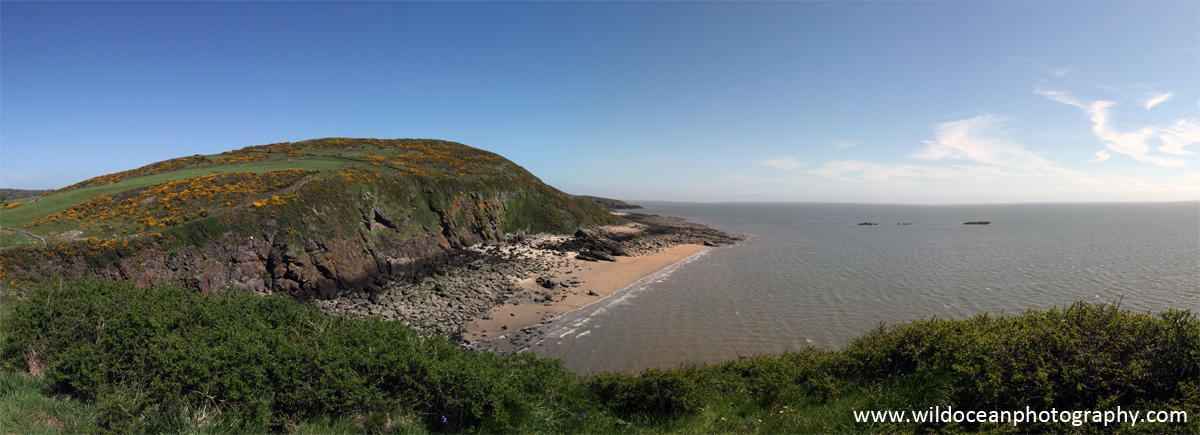
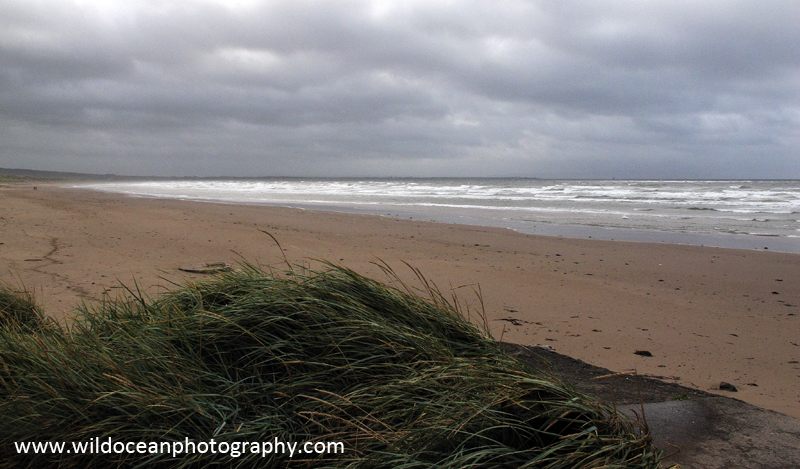
Showing posts with label coast. Show all posts

Sunday, 14 June 2015

North Queensferry / Carlingnose Reserve

The Forth Rail (and road) bridge at North Queensferry, as seen from Carlingnose Reserve.

North Queensferry is probably best known for their stunning views of the Forth Rail Bridge, and possibly for the Deep Sea World aquarium (if you haven't been, it's VERY cool!) However, the Scottish Wildlife Trust also run a lovely little reserve at Carlingnose Point with views looking west over the Firth of Forth.  ... If you can find it that is!

North Queensferry (link to map)

We parked at a car park underneath the rail bridge, found a sign showing that we were not only in the right place, but a mere stone's throw away from the reserve. It then took us about an hour of wandering the town and scrambling unnecessarily over the boulder shore before we admitted defeat, went back to town and managed to find the path leading to it.

There was a lot of really interesting dried out pieces of driftwood along the shore.

Top tip: if you ever arrive looking for the reserve yourself, there are no signs in the town, but you'll find it if you follow the signs for the Fife Coastal Path and head away from the town (or away from the grey road bridge if that's easier).

Look for the Fife Coastal Path and follow it west. There are no signs for the Carlingnose Point Reserve in town that I could find. 

The reserve itself is in place to protect locally rare populations of wildflowers and plants, and the dense scrub provides a nice habitat for smaller birds as well but it's also a nice viewpoint to look for seabirds on the shore. We visited in May and only saw a couple of eider ducks, but it was a really sunny day and it's possible that the birds had all finished foraging early in the morning and headed away to roost by the time we arrived.

The reserve was small and pretty quiet on the day we visited, but the vast fields of gorse were stunning!

There's an old ruined pier just offshore that had a sleeping gull on it, but the wildlife was keeping fairly quiet on the day we visited.

An old ruined pier lies just offshore off the reserve.

Sunny afternoons are perfect for napping, no matter what species you are!

The reserve itself is pretty small, but if you follow the Fife Coastal Path, you'll be led down to a big sandy bay where you get some lovely views over the Firth of Forth.

Following the coastal path brings you to this beach which was covered in oyster shells.
A group of cormorants were out enjoying the sun on the edge of the shore too.

The beach was also covered in oyster shells, which is pretty unusual and the first time I can remember seeing any - especially in such large numbers!

Shells from what I think might be native oysters (Ostrea edulis). I included a 10 pence coin for scale, which has a diameter of roughly 25 mm.  

I suspect they're possibly native oysters (Ostrea edulis), but I'm not an expert on these animals. If anyone knows what these are, it'd be really interesting to know.

North Queensferry and the road and rail bridges over the Firth of Forth.

Back in the town, you will of course be treated to some stunning views of the road and rail bridges, but the town itself is beautiful and quite typical of a coastal Fife town so it's well worth saving a little time to look around the town and its harbour before you leave. It's sometimes also possible to see dolphins in the tidal races underneath the rail bridge, so they're worth looking out for too!

The new road bridge being constructed. 

This year (2015), they're also in the process of building a new bridge over the river and it's pretty cool just to see the scale of the engineering works that are happening just now.


Thursday, 11 June 2015

The Ayrshire Coast (Stranraer to Girvan)


The view out to Ailsa Craig.

After exploring around Rockcliffe, we drove out west to the Ayrshire coast. The road from Stranraer to Girvan follows the shore very closely, and has plenty of large parking places which make it really easy to stop and have a look around. I've found this stretch of coastline to be pretty good for seabirds in the past, and it didn't disappoint this time around either!

We stopped at Carleton Bay, close to Lendalfoot.

The bit we stopped in this time was close to Lendalfoot at Carleton Bay - if you follow the signs for the Russian naval memorial you'll find it. Being relatively close to Ailsa Craig, it's also usually a good area to look for gannets, and this time was no exception.

This is a composite image (obviously. No-one gets this lucky!), of a gannet diving just off the beach. It took longer to make than I'd like to admit!

Of course, early summer is also the time when eider ducks breed, and usually hatch their chicks in late May - early June. This is a lot earlier than most of the other seabirds will be hatching their chicks, so if you go to any of the big seabird colonies like the Isle of May or the Farne Islands, they can be easy to miss if you're not on the ball. Anyway, eider ducklings have been on my photography wishlist for a while now, and I was pretty pleased to find that there were quite a few groups of them around this patch of coastline, and pretty delighted to spot the little ducklings in amongst the adults!

Eider ducks fighting about something while a bunch of seals look on in the background. 

So delighted that I didn't actually notice there were a group of common seals basking just offshore until I looked at the photos later on my computer!

An eider duck family settling in for a nap. The duckling is just visible underneath its mum (the brown one).

Eventually, one pair of eiders came into the shore with a chick and settled down in a rather photogenic fashion for a snooze, and I finally got my first decent photo of an entire eider duck family!

An oystercatcher exploring the shore.

Of course, that's not all there was to shoot. A group of shags were making good use of an exposed line of rocks to rest on for the evening, and a rather bold oystercatcher was happy to pose for a few photos before wandering off again!

30 shags sitting on a rock...

Wednesday, 10 June 2015

Rockcliffe to Sandyhills coastal walk (Solway Coast)

The rocky shores at Rockcliffe (low tide).

I went for a bit of an explore around the Solway and Ayrshire Coasts a couple of weeks ago to find some new places to make longer visits to in the future. So, with the dog and my mum in tow, we headed south and started our wanderings at the descriptively-named town of Rockcliffe (which is indeed both rocky and cliffy). From here, there's a coastal walk along a very nice rocky shore and out along the sea-cliffs to the sandy bay at Sandyhills (where there is sand and hills!). The walk itself is about 4.5 miles in each direction, and there is an infrequent bus service that will take you from Sandyhills back to Rockcliffe if you'd prefer not to retrace your steps.

The towns of Rockcliffe and Sandyhills are connected by a lovely coastal walk along the sea cliffs.

There's an easy path that meanders just above the top of the shore if you prefer not to scramble around on the rocks.
The shore around Rockcliffe is volcanic and rocky, with loads of wild plants and a small stretch of woodland running along the at the top of the shore and decent rockpools over the shore itself. Beyond the rocky shore, the coast extends out onto a large mudflat. We didn't see too much in the way of seabirds over the flats, although there were a few of the usual oystercatchers and gulls foraging on the edge of the water as the tide came back in. One of the problems I find with sunny days in the summer though is that most animals get up at the crack of dawn, feed early and then chill out for the rest of the day, so it may just have been bad timing on our part!

Looking up the coast from Castle Point. The path follows the cliffs east to a big sandy bay at Sandyhills.
The path takes you through the edge of the town, past a smuggler's grave and up to Castle Point, which is where the main cliff walk begins.

The view to Sandyhills. This was as close as we got on this occasion!
I was hoping there might be a few seabirds nesting on the cliffs, but there weren't really any to be found the day we visited. A couple of gulls flew past us but there certainly wasn't too much to see in terms of seabirds when we were there!

Looking down over the seacliffs
Saying that, the views along the coast were stunning and the shores around Rockcliffe are beautiful for exploring. We unfortunately weren't able to follow the path all the way to Sandyhills on this particular trip because the dog got too excited about life and cut his foot rather badly on the beach. Not that he noticed or cared particularly (and he's completely fine now!), but we did have to curtail our wanderings and pop him back in the car!

A hooded crow on the shore.
Our happy, oblivious dog.

After Rockcliffe, it was time to head west to Stranraer and the Ayrshire coast, which I'll tell you all about in the next update! [Spoilers: I found a LOT more wildlife to photograph!]


Tuesday, 7 April 2015

Foggy day in Tentsmuir National Nature Reserve

I'm not going to lie, yesterday's trip to the Tentsmuir National Nature Reserve (NNR) wasn't exactly the most successful photographic outing I've ever been on! On what was otherwise a beautifully hot and sunny Easter Monday for the vast majority of the UK, it would appear that the North Sea had other ideas...

The forest edge shrouded in fog was cool and slightly eerie!
Click for a larger version.

By the time I got to the Firth of Tay, it was clear that the North Sea was producing one of its characteristic haars. But, it was fairly light cloud and so I figured it would burn off soon enough as the sun got stronger through the afternoon. The NNR isn't very well signposted from the road so it did take a while to find the place, but I eventually arrived at Tentsmuir Forest (there's a £2 car park fee if you're planning on visiting).

British beach holidays are traditionally a slightly grim affair.
Click for a larger version.

The fog was far thicker by the coast, and gave the forest edge a cool, "Game of Thrones" type atmosphere. I still thought it would probably dissipate pretty quickly though, so I set off, following another intrepid British family who were obviously not going to let some inconvenient weather ruin their bank holiday at the beach.

A pool near the edge of Tayport Heath NNR. I'm sure the North Sea was behind it somewhere...
Click for a larger version.

I headed north into the haar and walked up the sandy coast for about 3 miles.

Still foggy! It was pretty cool though.
Click for a larger version.

The fog didn't burn off.

Ringed plovers scooted by a couple of times while they were foraging at the top of the shore.
Click for a larger version.
I THINK that this might be a skylark. Can anyone confirm the ID for me?

As you might expect, I didn't see too much in the way of wildlife! A couple of ringed plovers dashed by as they foraged along the strandline, and there were small birds darting around the dunes that I think might have been skylarks. If anyone can confirm the ID from the photo above, it would be much appreciated!

The weather was lovely 200 m from the shore!

After I gave up on the coast, I walked the 2 miles back to my car through the forest. It turned out that the fog only extended about 200 m inshore though before giving way to beautiful sunshine... I tried not to take it personally! Still, although there were tons of songbirds in the trees the forest itself was a little too full of holidaymakers to really offer many photographic opportunities.

Despite the unlucky weather, the reserve was a lovely place to spend a day and isn't that far from Glasgow for a trip out. The information spots promised that the beaches are good seal haul-outs (for grey and harbour seals) and are good places to see flocks of wading birds and eider ducks. Maybe next time!

Wednesday, 11 March 2015

Troon Beaches & Harbour

Troon is a small town in Ayrshire on the west coast of Scotland, and is one of the places I try and get to with my camera at least two or three times a year. Aside from being conveniently close to Glasgow for a day trip, it is has a really varied coastline which makes it a great spot for photographing coastal birds.

Troon's beaches are conveniently close to Glasgow and Ayr.

Birds on the Beaches


A windy day at one of Troon's beaches

The beaches around Troon are mainly sandy with smaller patches of bedrock. This combination of habitats means that you get a really nice mix of different birds along the coast. The sandy areas are used as feeding grounds by wading birds like curlew, oystercatchers and dunlin, while smaller species like plovers, redshank and turnstones can be spotted feeding in the seaweeds around the rocky areas.

Redshank are a common sight on the rockier places

Turnstones are also quite easy to find!

This pair of Dunlin were too busy foraging around the edges of a freshwater stream to worry about me an my camera.

These beaches are really popular with local dog walkers (for good reason!), so do bear that in mind before you head down. Most folk tend to stay towards the upper parts of the beach, but there's so much space there's plenty of room for everyone. It also means that most of the wildlife here is quite used to humans, and although they won't tend to let you walk right up to them, they are a bit more tolerant of disturbances than in other places and will settle down again fairly quickly.

The beaches are popular with dog walkers too

Obviously, that doesn't mean you get a free pass to cause a disturbance to the wildlife yourself! They are still wild animals, and it is our job as photographers and wildlife-watchers to make sure that we respect that and don't disturb them. As a general rule of thumb, you can tell quite easily when an animal has noticed you: that's a good time to stop approaching them.

Seascapes

The views over to Arran are gorgeous on nice days...

The views from Troon look out over to the Isle of Arran, which can provide a really nice backdrop for any seascapes you might want to try. Also, when the weather turns, it's quite easy to find cool bits of coastline close to the road, so you can get some stormy shots of the sea without having to stray too far from shelter!

... And really cool on the stormy days!

Troon Harbour 


Gulls annoying a grey seal.
While you're here, it's worth remembering that Troon has a working harbour that is used by a decent number of fishing boats that fish the Clyde for Langoustines, and where there are fishing boats, there are usually grey seals!

Eider ducks in the harbour at Troon.

Troon harbour is also a surprisingly good place for Eider Ducks, and there seems to be a large population of the birds living in and around the harbour! Unless you're able to visit a breeding colony (like the Farne Islands for example), I've always found eiders particularly difficult to approach, so the group at Troon was pretty exciting to find!

--------------------------------------

Like this? Why not check out some of my other Location Guides.

You can see these and many more of my photos over in the Wild Ocean Photography galleries

Sunday, 1 September 2013

Photos from Inverary

I'm back! If you're wondering where I've been, read on. If you just want to see some photos from Inverary, you can skip most of this and head straight down to the images!

So if you've been following this blog at all, you've probably noticed that things here have somewhat ground to a halt over the last three months and I have to admit it's entirely PhD-related. I'm coming up to the end of my 3rd year just now, and courtesy of a (really important) conference in June followed by two months working flat-out in an attempt to meet a self-imposed, unrealistic and unnecessary deadline, my stress levels have been creeping progressively higher for a while now. It's been more or less entirely self-inflicted too, but it's meant that I've not been going out to do the things that I find relaxing (like photography) because I've been feeling too guilty about not working. But then the stress gets higher and your work gets worse and all in all, it's a pretty bad place to be. It's fine when it's short-term, but not so great in the long run. I'm sure pretty much everyone has been there at some point.

Last week got to the point where the workplan clearly wasn't working, so I binned my deadline and went back to working the way that works for me (no Gannt charts!) and instantly felt better. This was also pretty much the point I noticed how crap the last 2-3 months have been, and when I also learned that if I don't want to go out with my camera to photograph wild things because of work, I'm probably working too much!

Anyway, this weekend I got the camera back out for wildlife for the first time since my last research cruise in April(!) and we headed up to Inverary (west coast of Scotland) for a day out with the dog. Since it was an an unusually sunny day the town was pretty busy, but there were still a few birds rummaging around the flats at low water when the dog wasn't charging around! I didn't get anything amazing, but here are a few of the better shots:

There were a LOT of jackdaws on the beach, which is a little unusual - most of the times I've been up that way it's been hooded crows everywhere.

These two had a brief fight over a patch of seaweed, which was over in about 5 seconds!

The bright sun didn't make for ideal shooting conditions without a polariser, but allowed for some nice silhouette shots. These are three redshanks and an oystercatcher feeding below the tide line.
Redshanks feeding along the shore.

Until the dog couldn't wait any longer to play in the sea and came to see what I was doing!

Most of the trips our dog gets to the seaside happen when I'm out to take photographs, so it was a pretty awesome day out for him too! Sonny's a rescue dog from the cat & dog home in Glasgow and can be pretty reactive around other dogs, so finding a quiet spot to let him off the lead and play is great!

Sonny
Of course, if I'm taking photos I'm not the one who has to dog-sit. I'm not sure if Kevin had quite as good a day as Sonny and I did!

Heading home via the Loch Fyne brewery, we spotted this small herd of red deer on the hillside too.

So that was our trip out! I'm fully intending to do this more often from now on, so with a bit of luck the blog posts will pick back up again over the next few weeks. Until then, don't forget you can keep up to date with my news and various happenings in the marine world via my facebook page at https://www.facebook.com/wildoceanphotography.