Showing posts with label seabirds. Show all posts

Wednesday, 24 June 2015

There's dolphins off the starboard bow!

As I mentioned in the last blog, we had to spend a couple of days travelling from Liverpool to Falmouth at the start of our cruise so that we could fix a problem with the ship (which went smoothly) and then transfer our remaining scientists on board ready to get to work. Because our research site is 300 km offshore, we tend not to see too much in terms of wildlife once we get over deep water so the extra time spent off the Welsh coast provided some nice opportunities for wildlife-spotting!

Hello down there!

We had really nice sightings of most of the usual suspects: kittiwakes, gulls, gannets and fulmars were the most common birds, as you'd expect really, but because we were a little further offshore we also had a few sightings of Manx shearwaters which was really nice. Shearwaters and petrels live almost entirely at sea (usually quite far offshore), and only come to shore to breed in burrows (a bit like puffins). Unfortunately, when they come ashore they're also nocturnal, which means your chances of seeing them are pretty small most of the time. I can't pretend I got any decent photos of them, but they are always nice to see!

A crappy photo of a distant Manx shearwater

We were also joined by a small pod of common dolphins en route, which looked like they had a calf or two with them. They didn't stay with us for too long, but they were bouncing around enough to grab a few shots! I've never had a great deal of luck photographing these guys because they move around so fast, but I'm pretty pleased with how these photos came out.

Common dolphins under a wave

 
Common dolphin
A small group of common dolphins leaping

Common dolphins

Oh - and we also briefly had a couple of stowaways with us too! They seem to have left us at Falmouth though so we won't be adopting them as cruise mascots!

A couple of racing pigeons briefly stowed away with us for a trip to Falmouth.

Thursday, 11 June 2015

The Ayrshire Coast (Stranraer to Girvan)


The view out to Ailsa Craig.

After exploring around Rockcliffe, we drove out west to the Ayrshire coast. The road from Stranraer to Girvan follows the shore very closely, and has plenty of large parking places which make it really easy to stop and have a look around. I've found this stretch of coastline to be pretty good for seabirds in the past, and it didn't disappoint this time around either!

We stopped at Carleton Bay, close to Lendalfoot.

The bit we stopped in this time was close to Lendalfoot at Carleton Bay - if you follow the signs for the Russian naval memorial you'll find it. Being relatively close to Ailsa Craig, it's also usually a good area to look for gannets, and this time was no exception.

This is a composite image (obviously. No-one gets this lucky!), of a gannet diving just off the beach. It took longer to make than I'd like to admit!

Of course, early summer is also the time when eider ducks breed, and usually hatch their chicks in late May - early June. This is a lot earlier than most of the other seabirds will be hatching their chicks, so if you go to any of the big seabird colonies like the Isle of May or the Farne Islands, they can be easy to miss if you're not on the ball. Anyway, eider ducklings have been on my photography wishlist for a while now, and I was pretty pleased to find that there were quite a few groups of them around this patch of coastline, and pretty delighted to spot the little ducklings in amongst the adults!

Eider ducks fighting about something while a bunch of seals look on in the background. 

So delighted that I didn't actually notice there were a group of common seals basking just offshore until I looked at the photos later on my computer!

An eider duck family settling in for a nap. The duckling is just visible underneath its mum (the brown one).

Eventually, one pair of eiders came into the shore with a chick and settled down in a rather photogenic fashion for a snooze, and I finally got my first decent photo of an entire eider duck family!

An oystercatcher exploring the shore.

Of course, that's not all there was to shoot. A group of shags were making good use of an exposed line of rocks to rest on for the evening, and a rather bold oystercatcher was happy to pose for a few photos before wandering off again!

30 shags sitting on a rock...

Tuesday, 19 May 2015

Seaton Cliffs

A couple of weeks ago, I headed up to the red sandstone coastline of the Scottish Wildlife Trust's Seaton Cliffs wildlife reserve. The reserve sits on the east coast of Scotland, just at the town of Arbroath. That's not a million miles away from the big seabird colonies at the Isle of May, Bass Rock and the Farne Islands and I was keen to see if there were any seabirds nesting along the cliffs since it would certainly be an easier (and cheaper) spot to get to than the islands of a weekend!

Wildflowers on the Seaton Cliffs with Arbroath in the distance.

Seaton Cliffs Wildlife Reserve. Link to Google Maps.

Almost as soon as we arrived at the reserve I realised that I'd left the battery for my DSLR in the charger at home which was... less than ideal! This led to the subsequent realisation that there is nowhere obvious in Arbroath to buy a battery for a Canon 7D. Fortunately, I had my trusty Canon G12 tucked away in my rucksack as well though, which turned out to be absolutely fine for the wildflowers and lovely scenery.

The red sandstone Seaton Cliffs.

A couple of snoozing gulls was the only bird life we saw on the cliffs for the first half an hour or so. We did walk VERY slowly though! 

Sauntering along the path from the car park in Arbroath, we were treated to lovely views of the cliffs and views over the North Sea, but not much in the way of birds. There were plenty of wildflowers though and lots of little white butterflies in amongst them which were lovely (but too skittish for my compact camera), as well as skylarks in the fields on the other side of the path.

A sandstone arch carved out by the sea.

My old dog certainly enjoyed the walk!

The cliffs themselves have been weathered into all kinds of shapes and structures, and it looked like an outdoor-adventure group were setting up ropes along some areas, presumably for a spot of cliff-walking or something similar. The walk was also clearly popular with dog-owners, so if you're looking for a more solitary experience, this might not be the place for you! Then again, it was also a beautifully sunny day when I visited which might have boosted the numbers a bit.

Kittiwakes and gulls nesting on Seaton cliffs. A couple of guillemots and shags were also present on the rocks by the shore, but may just have been passing through.

A northern fulmar (Fulmaris glacialis) on the cliffs.

Eventually, we did find a small bay which had quite a few kittiwakes, gulls and fulmars nesting on them, as well as a couple of guillemots and shags further down by the water. It wasn't a huge number of birds, but the cliffs were obviously protected enough from predators and the elements that it was good enough for some at least! If you're just looking for a few birds, this was a nice wee spot to see them, but it was nothing like as crowded with animals as the big island colonies, and there were definitely no puffins.

Cormorants, eider ducks and oystercatchers were happy to hang out in the bay next to the car park.

By the time we got back to the car, the tide had come in and there were a few more birds hanging out on the rocks just opposite the car park including a few cormorants, eider ducks and oystercatchers which was pretty cool. Later in the season it might be worth swinging by to have a look out for eider ducklings!


Wednesday, 11 March 2015

Troon Beaches & Harbour

Troon is a small town in Ayrshire on the west coast of Scotland, and is one of the places I try and get to with my camera at least two or three times a year. Aside from being conveniently close to Glasgow for a day trip, it is has a really varied coastline which makes it a great spot for photographing coastal birds.

Troon's beaches are conveniently close to Glasgow and Ayr.

Birds on the Beaches


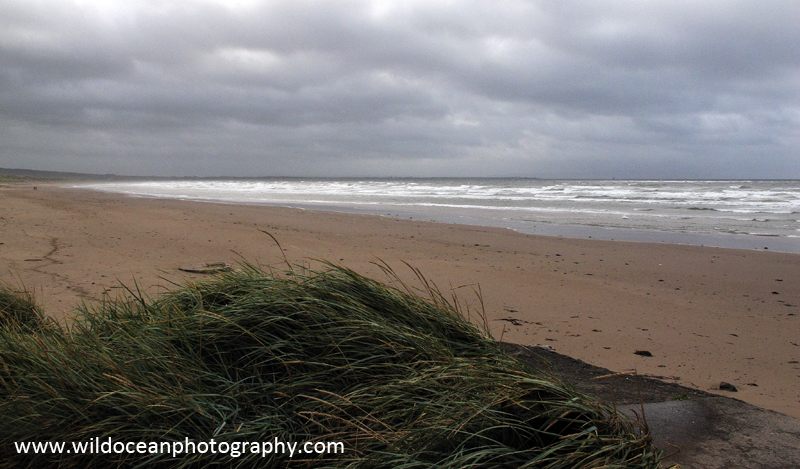
A windy day at one of Troon's beaches

The beaches around Troon are mainly sandy with smaller patches of bedrock. This combination of habitats means that you get a really nice mix of different birds along the coast. The sandy areas are used as feeding grounds by wading birds like curlew, oystercatchers and dunlin, while smaller species like plovers, redshank and turnstones can be spotted feeding in the seaweeds around the rocky areas.

Redshank are a common sight on the rockier places

Turnstones are also quite easy to find!

This pair of Dunlin were too busy foraging around the edges of a freshwater stream to worry about me an my camera.

These beaches are really popular with local dog walkers (for good reason!), so do bear that in mind before you head down. Most folk tend to stay towards the upper parts of the beach, but there's so much space there's plenty of room for everyone. It also means that most of the wildlife here is quite used to humans, and although they won't tend to let you walk right up to them, they are a bit more tolerant of disturbances than in other places and will settle down again fairly quickly.

The beaches are popular with dog walkers too

Obviously, that doesn't mean you get a free pass to cause a disturbance to the wildlife yourself! They are still wild animals, and it is our job as photographers and wildlife-watchers to make sure that we respect that and don't disturb them. As a general rule of thumb, you can tell quite easily when an animal has noticed you: that's a good time to stop approaching them.

Seascapes

The views over to Arran are gorgeous on nice days...

The views from Troon look out over to the Isle of Arran, which can provide a really nice backdrop for any seascapes you might want to try. Also, when the weather turns, it's quite easy to find cool bits of coastline close to the road, so you can get some stormy shots of the sea without having to stray too far from shelter!

... And really cool on the stormy days!

Troon Harbour 


Gulls annoying a grey seal.
While you're here, it's worth remembering that Troon has a working harbour that is used by a decent number of fishing boats that fish the Clyde for Langoustines, and where there are fishing boats, there are usually grey seals!

Eider ducks in the harbour at Troon.

Troon harbour is also a surprisingly good place for Eider Ducks, and there seems to be a large population of the birds living in and around the harbour! Unless you're able to visit a breeding colony (like the Farne Islands for example), I've always found eiders particularly difficult to approach, so the group at Troon was pretty exciting to find!

--------------------------------------

Like this? Why not check out some of my other Location Guides.

You can see these and many more of my photos over in the Wild Ocean Photography galleries

Wednesday, 27 March 2013

How to: Photograph Birds in Flight

A flying bird is probably one of the most challenging subjects you can try and photograph, and will require an enormous amount of patience to get good results. However, there are a few tricks and techniques that I have found make the process easier, and I hope they will be of some use to you!


Before you go:
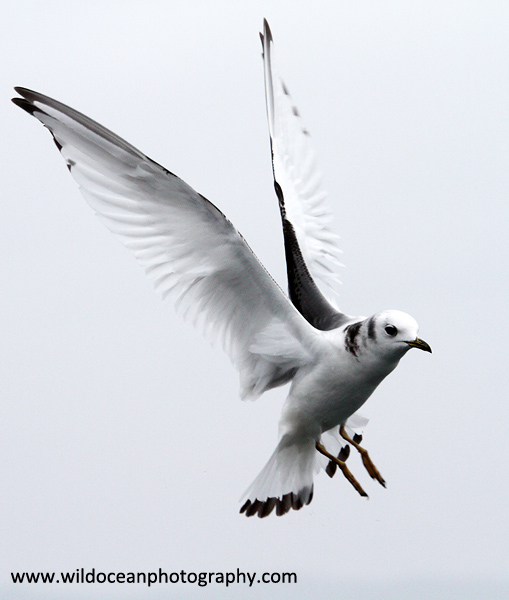
Kittiwakes are great birds to practice on if you can find them as they will fly in a repeating figure-of-eight pattern around the back of a boat as they follow it which makes them really predictable.
  1. Research your subject: You don’t need to predict exactly what species you’ll see on your trip, but it helps to have a rough idea as this will have a bearing on the best kit to take with you - you will need to take a different approach for fast and timid woodland birds compared to ducks at the park for example! Learning as much as you can about the general habits of the bird you want to shoot (e.g. preferred habitat, what it feeds on, what time of day it is most active) will also help you predict what they will do and where they will most likely be when you do get out into the field.

    Knowing the size of the bird, and how close they are likely to come to you are also aspects worth considering when picking your equipment. You may only need a short lens to photograph gulls flying around a seaside town for example, but may require a much longer one to photograph those small finches in a forest. If you know you are only going to have a short time on-site to see some behaviour (e.g. gannets diving at Bass Rock) then spend some time watching videos of it on YouTube or similar so you will have some idea of what to expect.
  2. Set up your kit (and know how to use it!): Birds in flight obviously tend to move very quickly, and you’ll need to be able to adjust your camera settings rapidly to keep up and make sure you get the shot. Which settings you prefer to use are up to you, but I usually set my camera (an affordable and quick Canon 7D) to:
      • Manual Mode: Unless the light levels are changing rapidly, this will make your life MUCH easier as it's one less thing to worry about while you're tracking your subject, particularly if the brightness of the background is very variable.
      • Fast burst shooting: I don't advocate just holding down the shutter button whenever anything happens until your camera buffer fills up, but taking a burst of shots at the peak of the action can often be the difference between a clipped wingtip or a less-attractive posture and a really nice photo.
      • Autofocus on (central point): The central autofocus points are generally more accurate on most (non-professional) camera bodies and I stick to them to ensure a higher 'hit rate' for birds on the move.
      • Shutter speed > 1/1000s: Seriously, this makes all the difference in the world! It doesn't matter if you can hand-hold your camera and long-lens at 1/50s, the pictures WILL look fuzzier than if you get the shutter speed up. If this means you need a higher ISO then use it, but get the speed up as high as you can get it.
      • Aperture: Usually I'll leave this wide open, but I might knock it down to F8 if the autofocus is struggling or if I'm being rolled around a lot like on a boat and I want to make sure the bird's face (especially the eyes) are sharp.
Quick lenses are expensive, but the improvements in auto-focus speeds and smoothness can be worth the cost if you're looking to take your photography more seriously. For most of my wildlife photography, I use the Canon 300mm F4 IS L lens with a 1.4x converter which is absolutlely ideal for what I need. 

In the Field: 
You can use unusual lighting to great effect, but it might not always be what you're looking for! 
  1. Choose your spot: How much you can do this will obviously depend on where you are shooting, and whether you have to stay in a static public hide (as is the case in some nature reserves for example) or whether you have the freedom to move around. Wherever you are though, do make sure and consider your background (is it cluttered? Are there distracting elements?) and the lighting (do you really want your subject to be backlit? Is the target area in bright sunshine or shade?) as well as a good view of the birds you are wanting to photograph. It’s a massive disappointment to find out that you've nailed an in-flight shot, but the shot is ruined by a bit of brightly-coloured litter in the background or too much contrast.
  2. Just Watch: Unless an amazingly rare species pops up or something really unusual is happening, it’s worth spending a bit of time just watching your birds fly. Get used to watching their flight patterns and their general behaviours before you pick up your camera. Most animals display a relatively limited range of behaviours and it's usually possible to learn to predict which actions will precede a fight, take-off, diving or feeding for example. Similarly, different species will fly in very different ways - a heron has a 'lazy', slow flight style, whereas swallows are fast and far more erratic, but will congregate around specific feeding areas. A little bit of patience early on will mean you are in a much better position to predict when and where you are likely to get the shot. Shooting a couple of frames at exactly the right moment is usually better than just keeping your finger on the shutter button taking the 'spray and pray' approach!
  3. Too fast to track? Catch them at a set point: An alternative to tracking a fast bird, or one with an erratic flight path is to manually focus on a particular spot and wait for the bird to enter it. This is much easier if there is a point that the bird is repeatedly flying to (e.g. a food source) so you have something to pre-set your focus on, but with a combination of narrow aperture (for larger depth of field) and a high shutter speed you can get good results (especially if your camera has good high ISO performance!).

    If a bird is flying too fast to catch, try setting your focus manually to a target (in this case , the baby swallow or the bird feeder) and shoot the bird as it enters the frame. A tripod is very helpful to keep the point of focus in exactly the right place, but these examples were both taken handheld.
  4. Be aware of the whole scene: When you are totally focused on a bird in your viewfinder, making sure it is in the frame, in focus and looking lovely, it is very easy to forget the rest of the frame, and what is happening in the background, or to the light levels. If you shoot using one of the semi-automatic settings like aperture or shutter-priority, the camera should make allowances for any changes in the light, but you have to be aware of changes in the background that will confuse it. For example, when shooting seabirds, they quite often swoop and dive around the boats, meaning that the background is constantly changing between a dark blue sea, and a bright, (though usually grey) sky. It is very easy to get the exposure of the bird wrong as a result, and you need to be prepared to keep adjusting the exposure even as you are panning after the bird. This is one of the major reasons I prefer to use manual mode, because it involves a LOT less effort to keep the subject correctly exposed while tracking it!

    Shooting against the dark sea can throw off automatic metering when the bird flies back up and frames itself against the sky. Using manual exposure settings avoids this problem. 
  5. Finally, practice, practice, practice! This is absolutely the most important thing you can do. Once you know your camera and subject, there is nothing better than getting out and practicing with them.
Looking for more photography tips? Check out my other guides on how to compose a great wildlife photo and how to take photographs at sea.


Friday, 23 November 2012

2013 Calendars: Last chance to pre-order

Each year for the last few years, I've put together a Wild Ocean Photography calendar for sale in time for Christmas, and this year is no exception. Unlike previous years though, next week I'm heading to New Zealand for a conference and a couple of weeks holiday so the deadline for pre-ordering calendars has been brought forward to this weekend. So if you're looking for a Scottish-wildlife themed Christmas present for the bargainous price of just £10 (+P&P) then you'd better get your orders in quick because I'll be placing the order with the printers on Sunday evening. There will be a few extras which you can pick up later if you miss the pre-ordering deadline, but there won't be many and once they're gone, they're gone!

The calendars are all A3 size and printed double-sided on high quality card with a silk finish. The proof copy looks really nice this year with the new design so I'm sure you'll not be disappointed!

For more information and to order yours, check out the calendars page on the WOP website at: http://www.wildoceanphotography.com/2013-calendars

The designs for this year are:

Cover
January
February
March
April
May
June
July
August
September 
October
November
December
Back cover