Showing posts with label wild ocean photography. Show all posts

Tuesday, 19 May 2015

Seaton Cliffs

A couple of weeks ago, I headed up to the red sandstone coastline of the Scottish Wildlife Trust's Seaton Cliffs wildlife reserve. The reserve sits on the east coast of Scotland, just at the town of Arbroath. That's not a million miles away from the big seabird colonies at the Isle of May, Bass Rock and the Farne Islands and I was keen to see if there were any seabirds nesting along the cliffs since it would certainly be an easier (and cheaper) spot to get to than the islands of a weekend!

Wildflowers on the Seaton Cliffs with Arbroath in the distance.

Seaton Cliffs Wildlife Reserve. Link to Google Maps.

Almost as soon as we arrived at the reserve I realised that I'd left the battery for my DSLR in the charger at home which was... less than ideal! This led to the subsequent realisation that there is nowhere obvious in Arbroath to buy a battery for a Canon 7D. Fortunately, I had my trusty Canon G12 tucked away in my rucksack as well though, which turned out to be absolutely fine for the wildflowers and lovely scenery.

The red sandstone Seaton Cliffs.

A couple of snoozing gulls was the only bird life we saw on the cliffs for the first half an hour or so. We did walk VERY slowly though! 

Sauntering along the path from the car park in Arbroath, we were treated to lovely views of the cliffs and views over the North Sea, but not much in the way of birds. There were plenty of wildflowers though and lots of little white butterflies in amongst them which were lovely (but too skittish for my compact camera), as well as skylarks in the fields on the other side of the path.

A sandstone arch carved out by the sea.

My old dog certainly enjoyed the walk!

The cliffs themselves have been weathered into all kinds of shapes and structures, and it looked like an outdoor-adventure group were setting up ropes along some areas, presumably for a spot of cliff-walking or something similar. The walk was also clearly popular with dog-owners, so if you're looking for a more solitary experience, this might not be the place for you! Then again, it was also a beautifully sunny day when I visited which might have boosted the numbers a bit.

Kittiwakes and gulls nesting on Seaton cliffs. A couple of guillemots and shags were also present on the rocks by the shore, but may just have been passing through.

A northern fulmar (Fulmaris glacialis) on the cliffs.

Eventually, we did find a small bay which had quite a few kittiwakes, gulls and fulmars nesting on them, as well as a couple of guillemots and shags further down by the water. It wasn't a huge number of birds, but the cliffs were obviously protected enough from predators and the elements that it was good enough for some at least! If you're just looking for a few birds, this was a nice wee spot to see them, but it was nothing like as crowded with animals as the big island colonies, and there were definitely no puffins.

Cormorants, eider ducks and oystercatchers were happy to hang out in the bay next to the car park.

By the time we got back to the car, the tide had come in and there were a few more birds hanging out on the rocks just opposite the car park including a few cormorants, eider ducks and oystercatchers which was pretty cool. Later in the season it might be worth swinging by to have a look out for eider ducklings!


Wednesday, 11 March 2015

Troon Beaches & Harbour

Troon is a small town in Ayrshire on the west coast of Scotland, and is one of the places I try and get to with my camera at least two or three times a year. Aside from being conveniently close to Glasgow for a day trip, it is has a really varied coastline which makes it a great spot for photographing coastal birds.

Troon's beaches are conveniently close to Glasgow and Ayr.

Birds on the Beaches


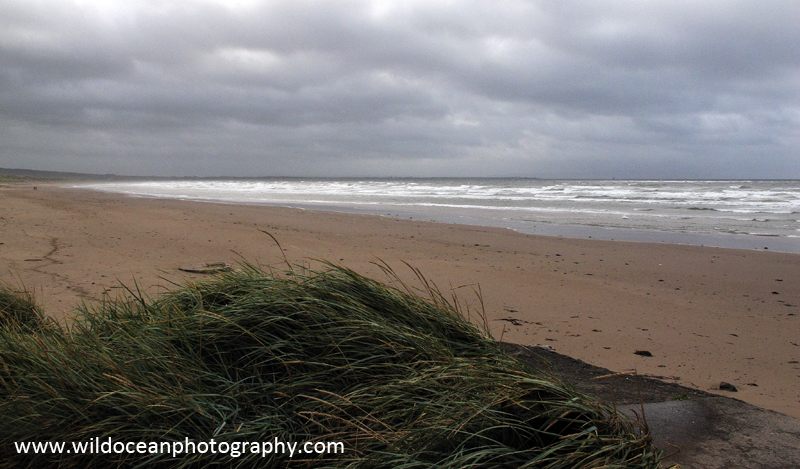
A windy day at one of Troon's beaches

The beaches around Troon are mainly sandy with smaller patches of bedrock. This combination of habitats means that you get a really nice mix of different birds along the coast. The sandy areas are used as feeding grounds by wading birds like curlew, oystercatchers and dunlin, while smaller species like plovers, redshank and turnstones can be spotted feeding in the seaweeds around the rocky areas.

Redshank are a common sight on the rockier places

Turnstones are also quite easy to find!

This pair of Dunlin were too busy foraging around the edges of a freshwater stream to worry about me an my camera.

These beaches are really popular with local dog walkers (for good reason!), so do bear that in mind before you head down. Most folk tend to stay towards the upper parts of the beach, but there's so much space there's plenty of room for everyone. It also means that most of the wildlife here is quite used to humans, and although they won't tend to let you walk right up to them, they are a bit more tolerant of disturbances than in other places and will settle down again fairly quickly.

The beaches are popular with dog walkers too

Obviously, that doesn't mean you get a free pass to cause a disturbance to the wildlife yourself! They are still wild animals, and it is our job as photographers and wildlife-watchers to make sure that we respect that and don't disturb them. As a general rule of thumb, you can tell quite easily when an animal has noticed you: that's a good time to stop approaching them.

Seascapes

The views over to Arran are gorgeous on nice days...

The views from Troon look out over to the Isle of Arran, which can provide a really nice backdrop for any seascapes you might want to try. Also, when the weather turns, it's quite easy to find cool bits of coastline close to the road, so you can get some stormy shots of the sea without having to stray too far from shelter!

... And really cool on the stormy days!

Troon Harbour 


Gulls annoying a grey seal.
While you're here, it's worth remembering that Troon has a working harbour that is used by a decent number of fishing boats that fish the Clyde for Langoustines, and where there are fishing boats, there are usually grey seals!

Eider ducks in the harbour at Troon.

Troon harbour is also a surprisingly good place for Eider Ducks, and there seems to be a large population of the birds living in and around the harbour! Unless you're able to visit a breeding colony (like the Farne Islands for example), I've always found eiders particularly difficult to approach, so the group at Troon was pretty exciting to find!

--------------------------------------

Like this? Why not check out some of my other Location Guides.

You can see these and many more of my photos over in the Wild Ocean Photography galleries

Wednesday, 1 May 2013

New Deep Sea Gallery on Wild Ocean Photography

Good morning all!

Black coral from 800m

Now I'm back on land after a very muddy two weeks away, I've had a chance to update the website a little bit and have added a new 'Deep Sea Animals' gallery to the Marine ID section. You can check it out here:

http://www.wildoceanphotography.com/deep-sea-animals

And let me know what you think in the comments section below.

A polychaete worm living on a cold-water coral.


Friday, 23 November 2012

2013 Calendars: Last chance to pre-order

Each year for the last few years, I've put together a Wild Ocean Photography calendar for sale in time for Christmas, and this year is no exception. Unlike previous years though, next week I'm heading to New Zealand for a conference and a couple of weeks holiday so the deadline for pre-ordering calendars has been brought forward to this weekend. So if you're looking for a Scottish-wildlife themed Christmas present for the bargainous price of just £10 (+P&P) then you'd better get your orders in quick because I'll be placing the order with the printers on Sunday evening. There will be a few extras which you can pick up later if you miss the pre-ordering deadline, but there won't be many and once they're gone, they're gone!

The calendars are all A3 size and printed double-sided on high quality card with a silk finish. The proof copy looks really nice this year with the new design so I'm sure you'll not be disappointed!

For more information and to order yours, check out the calendars page on the WOP website at: http://www.wildoceanphotography.com/2013-calendars

The designs for this year are:

Cover
January
February
March
April
May
June
July
August
September 
October
November
December
Back cover

Saturday, 30 June 2012

Creel Fishing around the Scottish Coast

Every once in a while I like to skim back through my photo archives, looking for those images that I might have passed over or simply missed the first time around, to look at them again and to see if I can make anything out of them with a little bit of extra work.

Fishing boats moored up in the harbour at Kirkwall (Orkney Islands)

Last week I was reminded about a project I worked on during the summer of 2010 in which myself and a larger consortium examined the feasibility of different methods for monitoring inshore fish populations around Scottish coastal waters. Since I had a fair amount of experience of working with the fishing industry and conducting observer work by that point, I was asked to investigate the levels of fish bycatch that were being captured by the Scottish inshore creel (trap) fishermen, which ultimately ended up with myself and two of my colleagues (PhD student Kathy Dunlop and an undergraduate student Marie Fenton) embarking on a ten-day trip around virtually the entire Scottish coast, driving from Glasgow to Campbeltown, up to Skye (where we attemtped to camp for 3 days in a storm) then north to the north-east coast and up to the Orkney Isles, going out to sea with any fishermen who would allow us to observe them for a day and handing out questionnaires. It was slightly crazy, but a lot of fun!

A catch of brown crabs and the creels that caught them. The blue escape panels allow most of the undersize animals to leave the creels before they're hauled onto the boat.

Anyway, the results of that pilot study are available in the full report (freely available online here) if you're interested in the science that came out of the trial, but what I would like to share with you here are some of the photographs from that trip, with the emphasis very much on the fishermen and the catches rather than wildlife for a change! I usually tend to ignore photos that aren't strictly wildlife or animal-based when I do my first-pass edits so a lot of the more 'documentary' style shots get ignored, and this trip just happened to come at a chaotic period between finishing one job and starting a PhD so I've never really gone back to the photos again properly until now. When I went back through the images from this fishing trip I was really looking for images that stood out and told a story about the fishermen and their work rather than the wildlife and these are the best ones I think. I hope you enjoy them, and as always, I'd be keen to hear your thoughts on them, especially since this is not really an area of photography I've got much experience with!

NOTE: Some of the in-blog photos might look a bit odd because they've been resized automatically. To see the full-size versions (which are sharp) please click on the images.

Edible crabs and lobsters in a creel pot.

A fisherman working to empty and reset one of his langoustine creels


Lobsters boxed up and ready for sale to market. The pink bands stop them damaging each other with their claws.


Fishermen work quickly to empty and re-bait the creels so they can redeploy them for the next catch.

A fisherman working to empty and re-bait the creel.

A fisherman pulls a lobster out of one of his creels.

Fishermen working on their creels on a calm day in Orkney

A catch of lobster and brown crabs in a creel trap

Two fisherman working on their creels in the Small Isles (Eigg, Muck & Rhum)


Wednesday, 27 June 2012

Review: Canon 70-200mm F4 IS L

This lens rounds out the mid-range of my lenses, and is probably my favourite of the bunch. It is small and light but robust, and takes great images.

Canon 70-200mm F4 IS L

When I bought my first DSLR, the only lens I bought to go with it was the Sigma 70-300mm F4-5.6 APO DG, which for the price was a great beginner's lens to learn with. Unfortunately, you tend to get what you pay for with camera gear and after about 6 months or so I felt I was starting to reach the limits of what the lens could do in terms of speed (of both the AF and the aperture range at 300mm), and image quality so I started to look at upgrading. The first lens I found was the Canon 300mm F4 IS prime lens which I got a decent price on on ebay, but that meant I no longer had anything in the mid-zoom range. That was actually ok for a while since I was still spending most of my time shooting wildlife that was either small or far away, but once I started working on fishing boats and I began trying to photograph large birds at much closer range (gulls, gannets, skuas and kittiwakes mostly) I really needed something shorter than the 300mm lens to do it, and that's where the 70-200mm F4 IS came in.

The lens is relatively small and compact

The first thing that struck me about the Canon 70-200mm F4 IS L lens was the size of it - it is a relatively small and lightweight lens and looked rather unassuming when it came out of the box. After a few minutes on the camera though any doubts I might have had about the quality of this lens were thoroughly set aside! The autofocus on this lens (as with all Canon L lenses I've used) is silent and extremely quick to focus in 99% of circumstances (low contrast days pose more of an issue if there's grey birds against a grey sky over a grey sea) and the image stabilisation is a great help as it allows you to handhold at lower shutter speeds when shooting stationary or slow-moving subjects, or removing excess camera-shake while you're panning for an action shot. 


The 70-200mm F4 IS L was particularly useful for shooting kittiwakes which have a tendency to fly very close behind boats in a figure-of-eight path.

So how does the lens perform? As a wildlife lens, I'll admit it is pretty short for most purposes unless you're able to get up close to the action, or want to take wider-angle shots that convey more of a sense of habitat. For bird photography in particular I find it too short to be of much use in more than a handful of situations. It is however more than capable of capturing high-speed action shots outdoors and produces excellent results. It has also put up with the same rough handling that my other gear has (mud, salt, water, fish slime and many knocks and bumps) and has never given a hint of a problem, which is testament to the environmental sealing Canon add to their L-range lenses. But, at approximately £900-£1000 it's certainly not cheap, and unless you've already got a long lens I would advise against buying this one if you're interests are solely wildlife.

Silhouette at sunset

The bokeh is not as blurred as it would be at a wider aperture, but it's still very nice.


Where this lens really shines is in photographing people. The focal length means it produces no noticeable distortion of people's features that you see on wider lenses, and it produces a really nice bokeh when it's fully open which really helps separate your subject from the background. For photojournalism-style photography I can see this being an very good lens choice (though the whiteness does make you fairly noticeable...!), and it's an area I'm hoping to explore a bit more when I'm photographing for work.

The only real downside for me is that F4 is slower in low-light than it's F2.8 counterpart, so if you're shooting indoors or in poor conditions, particularly is you're wanting to shoot fast-moving subjects then you're going to need to use a higher ISO (assuming you keep your shutter speed high), which in turn results in some loss of image quality. How much of an issue that is will depend on your camera body, but with Canon recently releasing an updated version of the F2.8 version of this lens (the 70-200mm F2.8 IS L II), it's likely that good 2nd hand copies of the first version (which is reputedly a stunningly good lens) will be available for under £1000. If I was buying a lens in this range again today, and with no price difference between the two, I'd personally be tempted to go for the F2.8 and get the extra speed over the portability of the F4.