Showing posts with label people. Show all posts

Friday, 28 September 2012

Field Work in Angola: Part 2

So as I said in Part 1 of the Angola story, the whole reason we were out in Angola was to download this year's set of data from the DELOS observatory platforms. Of course, it didn't all go quite as we'd planned!

We arrived in the Luanda, Angola's capital city early on a Saturday morning in the middle of August which coincidentally turned out to be right before their four-yearly election governmental elections which in turn meant that we were instantly put on curfew by BP as soon as we left the hotel due to a planned public demonstration that same day! Still, after an eight-hour overnight flight I can't say I was too upset at getting some time to relax in a hotel room.

In the end it turned out that the demonstration never happened, but with the imminent elections and all the preparations taking place, we were delayed onshore for an extra week because the government commandeered all available helicopters and fast boats to move election officials around the country and we needed a helicopter transfer to take us to the ship where we'd be doing our servicing work. For the most part we had to stay in the hotel, but we did get out a few times to see a bit of city and visit various colleagues working in the labs and on the industry side of things which was a great benefit of being onshore for a little bit longer. Oh - and we also got to see humpback whales breaching just offshore while we were having lunch in a cafe by the beach!

A man-made beach in Luanda

Luanda was certainly a strange place to be and a difficult place to get to grips with, probably largely because we weren't really able to get out and wander around the city and most of what we got to see was either from the hotel or from inside taxies. Mostly, it felt like a country of extreme contrasts. Parts of Luanda were obviously enormously affluent, with 4- and 5-star hotels and new apartment buildings being built all along the waterfront, as well as a new parliament building and a new 'Copacabana'-styled strip along the coast in the centre of the city.

There is a huge amount of investment in construction going on at the moment throughout Angola.

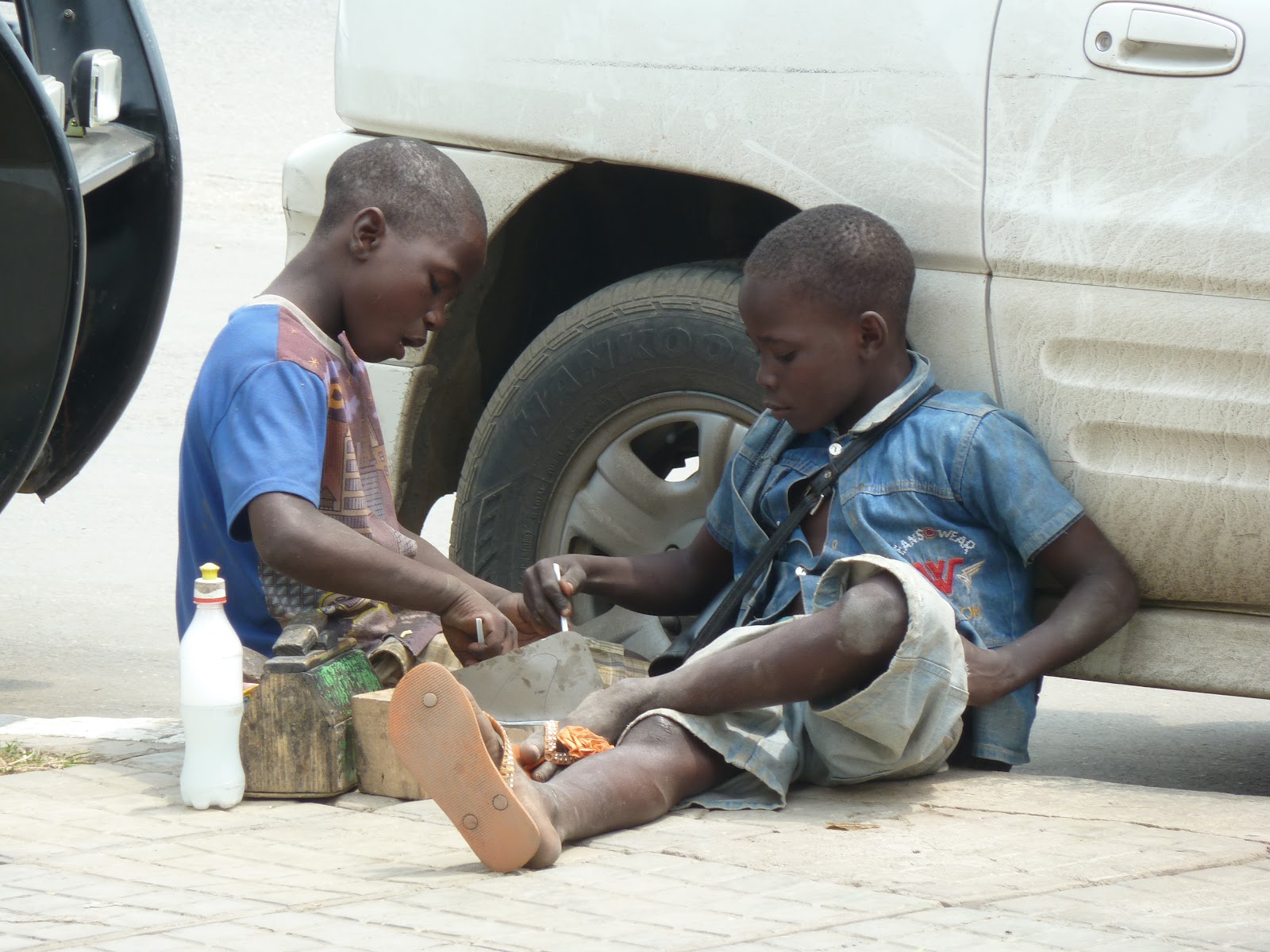
But surrounding everything were shanty towns with limited electricity, poor sanitation and absolutely no facility for disposing of any of the waste generated by so many people. A quick read through the BBC's webpage suggests that the majority of Angolans live on less than $2US per day, and while that figure may be an underestimate now, it's clear that most people are nonetheless very poor. It contrasts so sharply with the obvious wealth of the few that it's pretty disconcerting.

These boys earned their money shining shoes in the centre of Luanda.


Our hotel overlooked a litter-strewn bay and shanty town.


After a few days in the city, once the elections were over we managed to hire a car to take us down the coast a bit to a tourist lodge at the River Kwanzaa, about an hour or so south of Luanda for my first trip out into the country.

Not sure if these are baobab trees or something else, but they were a common sight in the scrub land as we drove down to the coast.

Heading down towards the Kwanzaa river, the habitat began to change more and more to forest.


The road down to Kwanzaa lodge

The view across the river

The scenery was pretty stunning as we drove down the coast, though the car wrecks which appeared every few hundred metres weren't totally reassuring! The region seemed to be mostly scrubland, but moving down towards the river we got into more and more forest and started to see a bit more wildlife which was very cool. No big game animals right enough, but plenty of birds and once we got to the Kwanzaa lodge there were also crabs everywhere which was pretty awesome (if you're a big marine biology nerd like me!)!


Ghost crab

Fiddler crabs displaying their oh-so-manly claws

A shore crab hiding in stranded water hyacyinth

Large rafts of water hyacinth washed up along the coast here

An effort had obviously been made made to keep the beaches tidy, but with nowhere to put the rubbish it just ended up in piles along the shore.
 
Cows on the road

Finally though, after an extra week onshore and one final extra day spent trying to convince the immigration guys at the airport that our (definitely valid) offshore visas were not expired and were in fact totally fine, we finally made it onto the helicopter and off to the Ocean Interceptor III where we would be working with an offshore ROV inspection team and collecting my data!


Saturday, 30 June 2012

Creel Fishing around the Scottish Coast

Every once in a while I like to skim back through my photo archives, looking for those images that I might have passed over or simply missed the first time around, to look at them again and to see if I can make anything out of them with a little bit of extra work.

Fishing boats moored up in the harbour at Kirkwall (Orkney Islands)

Last week I was reminded about a project I worked on during the summer of 2010 in which myself and a larger consortium examined the feasibility of different methods for monitoring inshore fish populations around Scottish coastal waters. Since I had a fair amount of experience of working with the fishing industry and conducting observer work by that point, I was asked to investigate the levels of fish bycatch that were being captured by the Scottish inshore creel (trap) fishermen, which ultimately ended up with myself and two of my colleagues (PhD student Kathy Dunlop and an undergraduate student Marie Fenton) embarking on a ten-day trip around virtually the entire Scottish coast, driving from Glasgow to Campbeltown, up to Skye (where we attemtped to camp for 3 days in a storm) then north to the north-east coast and up to the Orkney Isles, going out to sea with any fishermen who would allow us to observe them for a day and handing out questionnaires. It was slightly crazy, but a lot of fun!

A catch of brown crabs and the creels that caught them. The blue escape panels allow most of the undersize animals to leave the creels before they're hauled onto the boat.

Anyway, the results of that pilot study are available in the full report (freely available online here) if you're interested in the science that came out of the trial, but what I would like to share with you here are some of the photographs from that trip, with the emphasis very much on the fishermen and the catches rather than wildlife for a change! I usually tend to ignore photos that aren't strictly wildlife or animal-based when I do my first-pass edits so a lot of the more 'documentary' style shots get ignored, and this trip just happened to come at a chaotic period between finishing one job and starting a PhD so I've never really gone back to the photos again properly until now. When I went back through the images from this fishing trip I was really looking for images that stood out and told a story about the fishermen and their work rather than the wildlife and these are the best ones I think. I hope you enjoy them, and as always, I'd be keen to hear your thoughts on them, especially since this is not really an area of photography I've got much experience with!

NOTE: Some of the in-blog photos might look a bit odd because they've been resized automatically. To see the full-size versions (which are sharp) please click on the images.

Edible crabs and lobsters in a creel pot.

A fisherman working to empty and reset one of his langoustine creels


Lobsters boxed up and ready for sale to market. The pink bands stop them damaging each other with their claws.


Fishermen work quickly to empty and re-bait the creels so they can redeploy them for the next catch.

A fisherman working to empty and re-bait the creel.

A fisherman pulls a lobster out of one of his creels.

Fishermen working on their creels on a calm day in Orkney

A catch of lobster and brown crabs in a creel trap

Two fisherman working on their creels in the Small Isles (Eigg, Muck & Rhum)


Wednesday, 27 June 2012

Review: Canon 70-200mm F4 IS L

This lens rounds out the mid-range of my lenses, and is probably my favourite of the bunch. It is small and light but robust, and takes great images.

Canon 70-200mm F4 IS L

When I bought my first DSLR, the only lens I bought to go with it was the Sigma 70-300mm F4-5.6 APO DG, which for the price was a great beginner's lens to learn with. Unfortunately, you tend to get what you pay for with camera gear and after about 6 months or so I felt I was starting to reach the limits of what the lens could do in terms of speed (of both the AF and the aperture range at 300mm), and image quality so I started to look at upgrading. The first lens I found was the Canon 300mm F4 IS prime lens which I got a decent price on on ebay, but that meant I no longer had anything in the mid-zoom range. That was actually ok for a while since I was still spending most of my time shooting wildlife that was either small or far away, but once I started working on fishing boats and I began trying to photograph large birds at much closer range (gulls, gannets, skuas and kittiwakes mostly) I really needed something shorter than the 300mm lens to do it, and that's where the 70-200mm F4 IS came in.

The lens is relatively small and compact

The first thing that struck me about the Canon 70-200mm F4 IS L lens was the size of it - it is a relatively small and lightweight lens and looked rather unassuming when it came out of the box. After a few minutes on the camera though any doubts I might have had about the quality of this lens were thoroughly set aside! The autofocus on this lens (as with all Canon L lenses I've used) is silent and extremely quick to focus in 99% of circumstances (low contrast days pose more of an issue if there's grey birds against a grey sky over a grey sea) and the image stabilisation is a great help as it allows you to handhold at lower shutter speeds when shooting stationary or slow-moving subjects, or removing excess camera-shake while you're panning for an action shot. 


The 70-200mm F4 IS L was particularly useful for shooting kittiwakes which have a tendency to fly very close behind boats in a figure-of-eight path.

So how does the lens perform? As a wildlife lens, I'll admit it is pretty short for most purposes unless you're able to get up close to the action, or want to take wider-angle shots that convey more of a sense of habitat. For bird photography in particular I find it too short to be of much use in more than a handful of situations. It is however more than capable of capturing high-speed action shots outdoors and produces excellent results. It has also put up with the same rough handling that my other gear has (mud, salt, water, fish slime and many knocks and bumps) and has never given a hint of a problem, which is testament to the environmental sealing Canon add to their L-range lenses. But, at approximately £900-£1000 it's certainly not cheap, and unless you've already got a long lens I would advise against buying this one if you're interests are solely wildlife.

Silhouette at sunset

The bokeh is not as blurred as it would be at a wider aperture, but it's still very nice.


Where this lens really shines is in photographing people. The focal length means it produces no noticeable distortion of people's features that you see on wider lenses, and it produces a really nice bokeh when it's fully open which really helps separate your subject from the background. For photojournalism-style photography I can see this being an very good lens choice (though the whiteness does make you fairly noticeable...!), and it's an area I'm hoping to explore a bit more when I'm photographing for work.

The only real downside for me is that F4 is slower in low-light than it's F2.8 counterpart, so if you're shooting indoors or in poor conditions, particularly is you're wanting to shoot fast-moving subjects then you're going to need to use a higher ISO (assuming you keep your shutter speed high), which in turn results in some loss of image quality. How much of an issue that is will depend on your camera body, but with Canon recently releasing an updated version of the F2.8 version of this lens (the 70-200mm F2.8 IS L II), it's likely that good 2nd hand copies of the first version (which is reputedly a stunningly good lens) will be available for under £1000. If I was buying a lens in this range again today, and with no price difference between the two, I'd personally be tempted to go for the F2.8 and get the extra speed over the portability of the F4.


Friday, 15 June 2012

Zan is not a ninja photographer

And after what feels like no time at all, the cruise has come to an end and we are back in Glasgow. It's just as grey and wet as when we left all those weeks ago back in the middle of June, but it's definitely good to be home again for a break before the next one! I will post up some of the cruise highlights over the next few days once I've caught up on some sleep, but for now I wanted to share a small collection of photos that I've taken over the course of the cruise. I'm typically much more used to shooting wildlife, but by being one of the cruise photographers for the last month I've spent a lot more time than usual photographing people, which has been an excellent learning experience. I'm a huge fan of reportage-style photography and it's an area I'd like to develop into a bit more. Still, it doesn't always work out quite as planned and being spotted sneaking around with a long lens is not quite the look I was going for!

Here is the set of photos I like to call 'Zan is not a ninja':


Anyway, I'll be back soon with some more photos and some of my favourite images from the trip.

Saturday, 2 June 2012

A Day in the Life... On a Research Cruise


There’s nothing quite like the combination of fog, rain and a big swell at sea to really limit your options for photography! The weather yesterday and today has been too poor to put the ROV in the water and too foggy to get any decent photographs so we’ve had a quiet couple of days to catch up on some writing and data processing in the labs. But, all work and no play makes scientists at sea go crazy, so I thought today I’d write a little bit about a typical day on a research cruise and what we get up to out here to maintain some semblance of sanity!

Bet you can't spot me!
I’m writing this during my third offshore cruise, and during each one the scientists have been put on (usually 12-hour) shifts so we can keep working around the clock. The RRS James Cook costs about £50,000 per day to hire (including fuel, consumables and crew wages etc.) so it’s important to try and make the most of every hour we can get on board, especially since the chance to participate in a research cruise often represents a one-off opportunity to get your data. Unlike other fields, with deep-sea research it’s not like you can just pop 300 miles back offshore if you forget something or lose a sample! With that in mind, even working for 12 hours or more through a night shift doesn’t seem quite so bad.

So regardless of what time you actually wake up, a typical day will start, as it does anywhere, with breakfast and a coffee in the ship’s galley before checking in with the shift leader to see what the programme of work will be for the day. The shift leaders are responsible for keeping things running through their shift and will liase directly with the expedition’s Principle Scientist and to make sure that everyone gets the samples they need from the trip. They are also the ones who will be at the forefront when plans need to change to allow repairs to be done on a piece of kit or if bad weather comes in and forces us to rethink what we’re going to do for the day.

Nothing like a giant bucket of mud to keep everyone happy!
Since every research cruise is designed with a particular purpose in mind, the type of work being done will depend very much on what the aims are. The cruises I’ve participated in have mostly focused on ecological surveying using ROVs, towed cameras or trawling for example, but we’ve also done plenty of mud sampling, box coring, water collections and acoustic mapping as well. Regardless of what type of cruise it is though, one of the things I really enjoy about working on these ships is the real sense of camaraderie that develops from joining in with the deck work in particular, whether it’s carting buckets of water around for the on-board aquaria or being up to your elbows in abyssal mud at 2am on a pitching ship!

But like I said, you can’t work for 14 hours a day for 4 weeks straight without needing some downtime, and fortunately the cruise ships I’ve been on have been well-supplied in terms of entertainment. The James Cook for example has a video room for watching films in, a small library full of novels, a good-sized social area for watching TV and even a Wii with a few games! For me as well there’s also the photography to keep me busy, whether it’s shooting the wildlife or shooting photos of the work that we’re all doing.

Wii tournaments can get pretty intense
So that’s more or less it really for a typical day at sea! The weather has just kept on getting worse and the captain’s ordered the decks secured now while we head to our next station through a 3-4m swell (about 10-12 feet I think), but the birds seem to be thoroughly enjoying themselves so I’m off to try and get some shots of the stormy seas!

Thanks to Karl Attard and Millie Sharkey for providing today's photos :)