It's nice to be back at sea!
Last Friday, I left Glasgow with one of my fish-ecologist colleagues to join the RRS Discovery for another cruise to the Porcupine Abyssal Plain (PAP) long-term survey site. This is my fourth trip out to the PAP in as many years now, and I must admit it's really nice to be back on a ship!
 |
| Me and Jo, ready to sail! |
 |
| Leaving a wet and rainy Liverpool |
The main purpose of this particular cruise is to service the PAP monitoring buoy and download the data that it's been collecting for the past year. This includes oceanographic data (e.g. current speed, water temperature, salinity), as well as collections of the sinking particles of dead organisms, biological waste and other organic and inorganic materials that make up the "marine snow" which fuels the vast majority of deep-sea ecosystems.
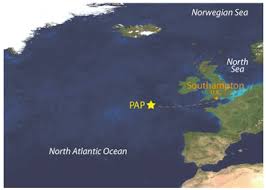 |
| The Porcupine Abyssal Plain (PAP) study site is about 300 miles south-west of Ireland |
 |
| Recoving the PAP buoy in 2013 |
Taking a ship 300 miles offshore is not a simple (or cheap!) task however, and there's no point coming all the way out here just to service a buoy and go home again so we've got a full contingent of scientists ready to make the most of the opportunity to collect their own data from the PAP site. On this particular cruise, we've got teams who are interested in understanding how mid-water bacterial processes and communities are influenced by "marine snow" particles, as well as researchers who will be studying the plankton communities and oceanography of the site. We even have a couple of holographic cameras which can automatically assess the sizes of all the particles in a tiny patch of seawater and rebuild an image of them all!
 |
| Some photos from the last time I was out here to fish in the abyss. Hopefully this time we'll catch even more! |
As exciting as the midwater research is though, I am here with Jo Clarke from Glasgow University to go fishing! We're working with the "benthic" (seafloor) ecologists from NOC to help collect deep-water animals from the seabed using mud cores, grabs and a trawl. We're really here for the fish, so we're mainly interested in the fish samples, and are here to make sure that they get identified, processed and recorded correctly for any future work that might be done on them. We'll also be helping out with all the other benthic sampling that needs to be done which will largely involve dealing with a lot of mud!
 |
| Sieving mud samples isn't so bad really! |
 |
| The megacorer is one of the standard sampling gears for getting good quality sediment and animal samples back from the seabed. We'll be seeing a lot of it over the next few days! |
So far we've had a pretty quiet start to the cruise. We met the ship in Liverpool and then spent a couple of days steaming south to Falmouth so some repairs could be done to one of the ship's thrusters while we were still near the coast. Happily that all went well, and we reached Falmouth just after midnight on Sunday for a mini crew-swap before starting our voyage to the PAP site. We should arrive there tomorrow, ready to start working!


