Showing posts with label DY032. Show all posts

Tuesday, 7 July 2015

Gone fishing...

On the offchance(!) that you aren't currently following the official Porcupine Abyssal Plain (PAP) Observatory blog, I thought I'd leave you a wee link to the post I wrote for them at the weekend about our trawling work. Enjoy!

https://papobservatory.wordpress.com/2015/07/06/gone-fishing/

Bringing the nets on board

The armoured grenadier, Coryphaenoides armatus, caught from 4850 m down!

Some of the other animals from the trawl catches. Left: Brittle stars (Ophiuroidea); Middle top: A sea cucumber (Holothuroidea); Middle: an Abyssal Grenadier (Coryphaenoides profundicolus); Middle bottom: an isopod; Right: A sea spider (Pycnogonidae)

Thursday, 25 June 2015

Whales!

Last night we were joined by a family group of pilot whales just as we were finishing dinner and preparing ourselves for our first night of seafloor sampling. Incidentally, running up and down two flights of stairs to get your camera after eating a large amount of lasagne and banana bread (separately, not at once!) is not an entirely pleasant experience!

A large pod of pilot whales popped by the ship yesterday.

Pilot whales in the waves

Pilot whales are funny beasts. They have a very lazy way of rolling through the water, which makes them a bit difficult to take interesting photographs of because they don't do much other than breathe and pootle about. The calves tend to be a lot more active and tend to leap around a bit more which is VERY cute to see if you can find a family group! 

Photobombing whale

Family of pilot whales

This pod had a couple of calves with them that still had visible foetal bands, meaning they must have been pretty new! We got really lucky with this group, and they stayed near the ship for about two hours. Most of the photos I took were of small black fins in the distance (as is typical of photographing whales and dolphins), but they did briefly come right up close to us and I got a few photos that were a bit more reasonable!


This pilot whale calf was so young the foetal bands were still visible on its flanks.

We've also been seeing a few shearwaters over the past couple of days. I'm not completely sure what species of they are, but I suspect they're Cory's shearwaters, though that's based mostly on the fact that I've seen them out here before and these ones look a bit similar. If anyone with a better internet connection than me can check and let me know it'd be much appreciated!

I think this is a Cory's Shearwater... Is that right?

Anyway, we've been put on night duty for our mud-coring work so I'm going to try and grab a couple of hours of sleep before dinner. See you next time!

Wednesday, 24 June 2015

There's dolphins off the starboard bow!

As I mentioned in the last blog, we had to spend a couple of days travelling from Liverpool to Falmouth at the start of our cruise so that we could fix a problem with the ship (which went smoothly) and then transfer our remaining scientists on board ready to get to work. Because our research site is 300 km offshore, we tend not to see too much in terms of wildlife once we get over deep water so the extra time spent off the Welsh coast provided some nice opportunities for wildlife-spotting!

Hello down there!

We had really nice sightings of most of the usual suspects: kittiwakes, gulls, gannets and fulmars were the most common birds, as you'd expect really, but because we were a little further offshore we also had a few sightings of Manx shearwaters which was really nice. Shearwaters and petrels live almost entirely at sea (usually quite far offshore), and only come to shore to breed in burrows (a bit like puffins). Unfortunately, when they come ashore they're also nocturnal, which means your chances of seeing them are pretty small most of the time. I can't pretend I got any decent photos of them, but they are always nice to see!

A crappy photo of a distant Manx shearwater

We were also joined by a small pod of common dolphins en route, which looked like they had a calf or two with them. They didn't stay with us for too long, but they were bouncing around enough to grab a few shots! I've never had a great deal of luck photographing these guys because they move around so fast, but I'm pretty pleased with how these photos came out.

Common dolphins under a wave

 
Common dolphin
A small group of common dolphins leaping

Common dolphins

Oh - and we also briefly had a couple of stowaways with us too! They seem to have left us at Falmouth though so we won't be adopting them as cruise mascots!

A couple of racing pigeons briefly stowed away with us for a trip to Falmouth.

Tuesday, 23 June 2015

To the Abyss (again!)

It's nice to be back at sea!
 
Last Friday, I left Glasgow with one of my fish-ecologist colleagues to join the RRS Discovery for another cruise to the Porcupine Abyssal Plain (PAP) long-term survey site. This is my fourth trip out to the PAP in as many years now, and I must admit it's really nice to be back on a ship! 

Me and Jo, ready to sail!

Leaving a wet and rainy Liverpool

The main purpose of this particular cruise is to service the PAP monitoring buoy and download the data that it's been collecting for the past year. This includes oceanographic data (e.g. current speed, water temperature, salinity), as well as collections of the sinking particles of dead organisms, biological waste and other organic and inorganic materials that make up the "marine snow" which fuels the vast majority of deep-sea ecosystems.
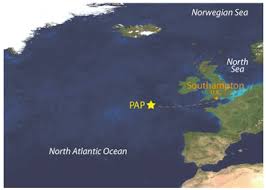
The Porcupine Abyssal Plain (PAP) study site is about 300 miles south-west of Ireland

Recoving the PAP buoy in 2013

Taking a ship 300 miles offshore is not a simple (or cheap!) task however, and there's no point coming all the way out here just to service a buoy and go home again so we've got a full contingent of scientists ready to make the most of the opportunity to collect their own data from the PAP site. On this particular cruise, we've got teams who are interested in understanding how mid-water bacterial processes and communities are influenced by "marine snow" particles, as well as researchers who will be studying the plankton communities and oceanography of the site. We even have a couple of holographic cameras which can automatically assess the sizes of all the particles in a tiny patch of seawater and rebuild an image of them all! 

Some photos from the last time I was out here to fish in the abyss. Hopefully this time we'll catch even more!
 
As exciting as the midwater research is though, I am here with Jo Clarke from Glasgow University to go fishing! We're working with the "benthic" (seafloor) ecologists from NOC to help collect deep-water animals from the seabed using mud cores, grabs and a trawl. We're really here for the fish, so we're mainly interested in the fish samples, and are here to make sure that they get identified, processed and recorded correctly for any future work that might be done on them. We'll also be helping out with all the other benthic sampling that needs to be done which will largely involve dealing with a lot of mud!

Sieving mud samples isn't so bad really!

The megacorer is one of the standard sampling gears for getting good quality sediment and animal samples back from the seabed. We'll be seeing a lot of it over the next few days!


So far we've had a pretty quiet start to the cruise. We met the ship in Liverpool and then spent a couple of days steaming south to Falmouth so some repairs could be done to one of the ship's thrusters while we were still near the coast. Happily that all went well, and we reached Falmouth just after midnight on Sunday for a mini crew-swap before starting our voyage to the PAP site. We should arrive there tomorrow, ready to start working!