Showing posts with label science. Show all posts

Tuesday, 7 July 2015

Gone fishing...

On the offchance(!) that you aren't currently following the official Porcupine Abyssal Plain (PAP) Observatory blog, I thought I'd leave you a wee link to the post I wrote for them at the weekend about our trawling work. Enjoy!

https://papobservatory.wordpress.com/2015/07/06/gone-fishing/

Bringing the nets on board

The armoured grenadier, Coryphaenoides armatus, caught from 4850 m down!

Some of the other animals from the trawl catches. Left: Brittle stars (Ophiuroidea); Middle top: A sea cucumber (Holothuroidea); Middle: an Abyssal Grenadier (Coryphaenoides profundicolus); Middle bottom: an isopod; Right: A sea spider (Pycnogonidae)

Tuesday, 23 June 2015

To the Abyss (again!)

It's nice to be back at sea!
 
Last Friday, I left Glasgow with one of my fish-ecologist colleagues to join the RRS Discovery for another cruise to the Porcupine Abyssal Plain (PAP) long-term survey site. This is my fourth trip out to the PAP in as many years now, and I must admit it's really nice to be back on a ship! 

Me and Jo, ready to sail!

Leaving a wet and rainy Liverpool

The main purpose of this particular cruise is to service the PAP monitoring buoy and download the data that it's been collecting for the past year. This includes oceanographic data (e.g. current speed, water temperature, salinity), as well as collections of the sinking particles of dead organisms, biological waste and other organic and inorganic materials that make up the "marine snow" which fuels the vast majority of deep-sea ecosystems.

The Porcupine Abyssal Plain (PAP) study site is about 300 miles south-west of Ireland

Recoving the PAP buoy in 2013

Taking a ship 300 miles offshore is not a simple (or cheap!) task however, and there's no point coming all the way out here just to service a buoy and go home again so we've got a full contingent of scientists ready to make the most of the opportunity to collect their own data from the PAP site. On this particular cruise, we've got teams who are interested in understanding how mid-water bacterial processes and communities are influenced by "marine snow" particles, as well as researchers who will be studying the plankton communities and oceanography of the site. We even have a couple of holographic cameras which can automatically assess the sizes of all the particles in a tiny patch of seawater and rebuild an image of them all! 

Some photos from the last time I was out here to fish in the abyss. Hopefully this time we'll catch even more!
 
As exciting as the midwater research is though, I am here with Jo Clarke from Glasgow University to go fishing! We're working with the "benthic" (seafloor) ecologists from NOC to help collect deep-water animals from the seabed using mud cores, grabs and a trawl. We're really here for the fish, so we're mainly interested in the fish samples, and are here to make sure that they get identified, processed and recorded correctly for any future work that might be done on them. We'll also be helping out with all the other benthic sampling that needs to be done which will largely involve dealing with a lot of mud!

Sieving mud samples isn't so bad really!

The megacorer is one of the standard sampling gears for getting good quality sediment and animal samples back from the seabed. We'll be seeing a lot of it over the next few days!


So far we've had a pretty quiet start to the cruise. We met the ship in Liverpool and then spent a couple of days steaming south to Falmouth so some repairs could be done to one of the ship's thrusters while we were still near the coast. Happily that all went well, and we reached Falmouth just after midnight on Sunday for a mini crew-swap before starting our voyage to the PAP site. We should arrive there tomorrow, ready to start working!

Friday, 4 January 2013

Friday of Interesting News: 4th Jan 2013

Happy New Year everybody and welcome to your first news roundup of 2013! As you might expect there are a lot of reviews of 2012 and 'best of -' lists kicking around on the internet at the moment, so here are a few of the better ones.

2012 Reviews
2012's most viral science videos
Top news stories from the London Natural History Museum
Animals that went extinct
Top 11 Ocean Stories of 2012
The top five posts from Deep-Sea News

Photography
TED-Ed: How Photography Connects Us
BBC's latest Attenborough Series 'Africa' started on Wednesday. Check out iPlayer if you missed it!

Marine Science News
Still looking for a New Year's Resolution? National Geographic has 10 for you!
Shell oil rig runs aground in Alaska
Record numbers of seal pups born in Norfolk this winter
Five organisms with real superpowers to rival their comic book counterparts
Deepest corals in the Great Barrier Reef discovered at 125m depth
Are jellyfish numbers really on the rise?
Poor weather washing Oceanic Sunfish ashore in the UK
Roman shipwreck reveals more secrets
Scott of the Antarctic may not deserve his bad reputation

Art & Design
Who wouldn't want one of these beautiful laser-cut wooden charts?
Ever wonder what a Narwhal really is? Ed Yong reveals all via twitter
Are your children not terrified enough of bathtime? Try these!
Must learn to knit one of these!
Enjoy!

Saturday, 29 December 2012

Saturday of Interesting News - 29th December

Ok, so I meant for this to go up every Friday, but yesterday I was in Fort William attempting to snowboard at the Nevis Range (sadly the weather had other plans...!) so I'm running a day late on the links. Better late than never though?

Here's the weekly roundup:

Photography
National Geographic photograph a shark eating another shark whole!
Not exactly marine, but BBC's new documentary series 'Africa' starts on Wednesday 2nd Jan.

Marine Biology

Design

Got any more news worth sharing? Send me an email at: info@wildoceanphotography.com

Friday, 21 December 2012

Friday of Interesting News: 21st Dec

So in the first edition of what I hope will be a regular occurrence, I welcome you all to the first Friday of Interesting News, where you can find out some of the fun and exciting things that have happened this week in the worlds of photography and marine science.

So without further ado, here we go:

Photography
Video of baby being attacked by an eagle was really a college assignment to create a viral hoax.
The storm over Instagram's apparent rights grab continues
Winners from the British Ecological Society's photo competition now online
Nature publish their Images of the Year
The story behind the 'Fish Tornado'

Marine Science
Millport Marine Station will close if they can't find alternative funding. Please show your support!
British efforts to drill into Lake Ellesworth in the Antarctic are on hold
Pygmy Right Whale may be a relic from a supposedly extinct family
The Discovery Channel have videoed a Giant Squid in its natural habitat for the first time! 
Injured coral? Expect less sex.
Humpback whales sing while feeding

And finally...
What do marine biologists wish for at Christmas? Twelve days of these please!
'Twas the Night Before Christmas... Plankton style!
Need a gift for that hard-to-buy-for relative? Maybe don't buy this...


Got any cool news for next week's roundup? Email me the link at info@wildoceanphotography.com


Tuesday, 18 September 2012

Field work in Angola: Part 1

So, after three weeks away to the west coast of Africa, I'm back to tell the tale! But before I launch into everything that we did out there, I'd better give you a bit of background on why we went.

Part of my PhD work is looking at the effects of deep-water oil production on the behaviour and composition of fish communities over time. While shalllow-water effects have now been studied in depth for a number of years, there is virtually no data available on the effects that oil production in the deep sea (>1000m) may have on the benthic (seabed) fauna, particularly on mobile species such as fish.

In shallow waters, oil rigs are known to provide artificial habitat for a variety of fish species, and the abundance of fish at such oil platforms can be far higher than in the surrounding waters. This knowledge has led to programmes such as 'Rigs-to-Reefs' in the US which convert decommissioned oil platforms into man-made reefs to provide artificial habitat for fish and invertebrates as well as protection from fishing activities such as trawling. Many shallow-water fish species are attracted to vertical structures and will use such open, complex structures to hide from predators or as feeding grounds once the reefs become colonised by invertebrate life. Even while they are operational, static platforms still provide hard substrate for invertebrates to live on and for mobile animals to live in and around.

Fish attracted to a decommissioned oil rig.
Image credit: http://www.guyharveymagazine.com/

However, the role of oil platforms in the deep-sea and their potential for providing artificial reef habitats are as yet unknown. While we might expect the effects to be similar in deep water as they are in shallow water we need to consider a couple of important differences in the behaviour of the fish themselves and the type of oil production structures present.

In the deep-sea, there is relatively little hard substrate; the majority of the seabed is comprised of soft sediments like muds and clays, and is typically rather featureless, particularly in the areas targeted for deep-water oil production fields. Consequently, we could expect the fish species that live in these areas to have relatively low affinity for hard substrates since natural reef structures are rare, and therefore that the presence of any reef structure would have relatively little effect on aggregating those species without some other attraction (e.g. a good food source).
 
Secondly, oil production structures in deep water are physically very different to those in shallow waters, and tend to be far more spread out over the seabed. The oil wells themselves are capped by wellheads which are a few metres in diameter, and which connect via pipelines to a central 'hub' which in turn connects a flexible pipeline to a floating surface production vessel. This means that the actual amount of 'reef space' provided by the structures is relatively low compared to shallow, static rigs and it is therefore unclear how much of an effect this might have on local fish populations.


An example of a deep-sea oil field with surface production vessels.
Image credit: http://angolarising.blogspot.co.uk/2011/11/big-oil.html


This is where I come in. As a part of my PhD, I'm using data collected by two seafloor observatory platforms situated off the west coast of Angola in 1400m of seawater and installed by BP through the DELOS project. One of the platforms sits around 50m from an active oil well (the 'Near Field' platform) while the other is located approximately 15km away from any production activity (the 'Far Field' platform) and acts as a control site. The platforms each contain a number of 'modules' which hold time-lapse cameras, environmental sensors, active and passive sonar sensors and a sediment trap at the far-field and we can use these to investigate how the environment varies naturally over time at each site and whether we can see any effects of either the oil production structures or natural environmental change on the fish communities present.

The DELOS platform frame (image from www.delos-project.org)

An ROV conducting an inspection of one of the DELOS platforms

We've been collecting data from these observatories since February 2009, and although there were some early teething problems which needed to be resolved, we've now got a very nice dataset covering three years from an area of the world about which very little is known about the marine environment at all, never mind the deep sea! However, while the platforms are designed to operate autonomously for the most part, they do need to be serviced each year for routine maintenance (swapping batteries etc.) and to download the data that's been collected over the previous 12 months. This all means that once a year, technicians from Oceanlab (University of Aberdeen) have to head south to the Angolan capital city of Luanda, and then offshore via helicopter to the ROV servicing vessel, work around the clock to get everything done in as short a time as possible, reinstall the modules into the observatories and head back home again with all the data.

Sounds pretty straightforward doesn't it?

Well, this year I was finally able to join the technical team and head down there myself to see the equipment that's been feeding me data for the last two years and learn how it all gets done! It wasn't quite as smooth sailing as we'd anticipated though...

Thursday, 23 August 2012

Heading Away Again...

So tomorrow I'm getting on a train, then an overnight plane, then a helicopter to take me to Angola where I'm helping out with the annual servicing of the DELOS platforms as part of my PhD. These are two observatory platforms which have been built in an oil production area off the coast of Angola and which I'm using to collect time-series data about the fish populations in the region at about 1500m water depth. The trip itself is entirely hosted by BP so I'll be completely safe, but I'm not sure at the moment how much of the work I'll be able to report back with on here, or if there will be any form of internet connection while we're offshore or in the hotels. In addition, we're heavily restricted on weight for the helicopter transfers so I'm not taking my big camera with me this time, and have borrowed a Panasonic Lumix for the trip instead. I have absolutely no doubt I'm going to miss my camera, but c'est la vie!

At the moment I have no idea what to expect either. I've never been to Africa, never been offshore and have a pile of malaria drugs that I've never taken before either. Wish my stomach luck with those! Still, we've been pretty thoroughly briefed and trained up for it all, including a Helicopter Underwater Escape Training course (!), had just about all the medical tests and jags in the world and bought a shiny new bright orange boiler suit for the occasion! And I still don't really know what I'm letting myself in for.

I'm hoping to be able to share some photographs with you all while I'm away and get a couple of blogs up and running. If not, I'll at least be able to fill you in when I'm home again in a couple of weeks.

Also, if you have been keeping an eye on the website (www.wildoceanphotography.com), you may have noticed a bit of a slow down in the rate of updating - this is largely due to a hard drive failure which corrupted all my web edits. Sigh. Let this be a lesson to keep regular backups. I only lost a couple of days work, so it's annoying rather than a catastrophe but still a pain in the ass!

Anyway, enjoy the rest of August and I will be back in a couple of weeks!

Monday, 23 July 2012

A tale of half a million photographs

Well, this week has been busy! After a couple of issues with one of the batteries, the AUV team managed to get Autosub working perfectly again and we've been conducting photographic missions to the seafloor over the last five days, covering a survey track approximately 150km long and taking over 500,000 photographs in the process! It's the biggest AUV survey of an abyssal  region conducted to date (to the best of my knowledge) which is very cool and I'm hoping it will allow me to examine the distribution patterns of fish on the seafloor.

Autosub6000 being launched!
(I love that they've had to write 'harmless scientific instrument' on it in case it's mistaken for a giant yellow torpedo!

Deep-sea fish (particularly abyssal ones) are pretty difficult to study, partly because as the depth increases there's less and less food available which means fewer and fewer fish are able to survive. So, by the time you reach the abyssal plains at 4000-6000m, there are relatively few individuals around to find. One way around this problem is to use baited camera systems to lure the fish into your photographs, and it is an extremely efficient way of assessing the abundance and diversity of scavenging species in an ecosystem. However, scavenging species only account for around 25% of the  total fish diversity in the deep waters of the north-east Atlantic, so we need to use other techniques to identify the other 75%. A potential solution is to use unbaited cameras (such as Bathysnap), set to take images every few hours over several months then record which species pass by the camera in that time. Alternatively, we could catch specimens using trawl surveys to cover a larger area (which has the additional benefit that we can get definitive identifications for the species we catch), but we can't tell exactly whereabouts each fish was captured along the trawl's path.


However, none of these methods are really suitable for examining what the distribution patterns of fish are on the seafloor (i.e. do they cluster together or are they spread evenly over the seabed?) or how they respond to variations in habitat (e.g. how they react to the presence of hills or hard substrate), which are fairly fundamental questions to consider in understanding the ecology of any species. This is where Autosub comes into the picture. 

The forward-looking camera & flash on Autosub which  I use to look for fish.

As an AUV (Autonomous Underwater Vehicle), Autosub can be programmed to dive to the seafloor, follow a survey route while operating any on-board equipment (like cameras or sonar systems) and then return to the surface and the research ship without requiring any human intervention during its mission. Not only does this free the ship to conduct other work while the Autosub is getting on with its surveys, but it can also be programmed to conduct extremely long or complex surveys which may not be feasible using other methods. For our work, Autosub was set to conduct photographic transects roughly 35km - 90km in length, taking photographs every 0.86 seconds at a speed of around 1m per second. In case your mental arithmetic is a bit creaky, that's approximately 4200 photographs per hour! 


EDIT: Hooray! I've had the OK to post a few images, so here are a few of the better ones. They're cropped from a 5MP camera so they're not amazing quality, but they do the job!


Bathysaurus sp. (lizardfish) is an ambush predator with rather a lot  of teeth. They're not really orange, but the camera has a funny colour balance going on that I've not fixed yet.


A (not-colour-corrected) grenadier from yesterday's mission.


And another little grenadier from the first mission we did.


Anyway, after a rather full-on five days or so of AUV operations and between the two stills cameras mounted on Autosub, we've amassed well over 550,000 images and covered around 150km of abyssal seabed! A preliminary look through the photos is showing a decent number of fish as well which is brilliant news and means I'm going home with a really nice set of (pretty damn exciting) data! All of this is exceptionally cool, but sadly combines with the 100 hours of ROV footage from last month's cruise to sound the final death knell for my social life. Well, that and the prospect of several weeks on an Angolan oil rig at the end of the year, but that's still to be confirmed...

Examples of the rubbish we trawled up from the Porcupine Abyssal Plain during last year's cruise.
One thing that takes the shine off all this cool and exciting research though is that despite the fact that we're conducting surveys in 5000m of seawater in an area which isn't commercially targeted for anything (no fishing, mining, oil drilling etc.), we're still seeing litter everywhere, from planks of wood and scraps of metal to canvas bags to old books and old drinks cans and bottles. Last year when we were out here we trawled up boots, bottles and twice as much spent fuel (clinker) as animals by weight. It sucks. You'd think that maybe somewhere as remote as the ocean abysses might just be far enough away from us that they'd still be relatively pristine, but it's certainly not the case out here.


Finally, Jen Durden and I have written up a blog for the NOC's 'Picturing the Deep' blog which will hopefully go up online tomorrow (Tuesday at the latest I'd expect) so you can see some of it there at least in the meantime! 


Monday, 16 July 2012

Compressing Confectionery at 5000m

Because most of the research I do is largely based on survey work with a dash of theoretical modelling, I don’t get to spend a lot of time working in the lab or designing experiments. However, this time I came to sea armed with a plan!


Mmmmm.... Sciencey!


As you may remember from previous cruises, people typically spend a lot of their downtime drawing designs on polystyrene cups, sending them to the seabed and letting the high pressure of the seawater crush them into miniatures. After making plenty of my own cups, the novelty began to wear off a bit and I started wondering what would happen to other things if you sent them into the abyss. In particular, I wondered what would happen to air-filled chocolates.

So, before I joined the ship I bought myself a bag of fun-size sweets containing Maltesers, Milky Way Stars, Milky Ways, Mars bars  and Starburst (or Opal Fruits if you’re still determined to remain old skool about it). With the exception of the starburst, all of them contain air-filled spaces to a greater or lesser extent, and although I didn’t formally measure the volume of air in each type, I would estimate that the maltesers have the most air with starburst having the least. I would have also liked to have sent down Aeros and Wispas to see what happens to them, but my local supermarket has a crap selection and this was all they had in the mini-sizes. Now, on to the science part!

Hypotheses
  • The high pressure of the abyss (approximate 480 atmospheres) will crush the Maltesers and Milky Way Stars (being relatively brittle) completely. (Null hypothesis: Maltesers and Milky Way Stars will not crushed by the pressure.)
  • The high pressure of the abyss will cause the Milky Ways and Mars Bars to shrink by reducing the volume of air in the nougat. (Null hypothesis: Size will remain the same.)

I didn’t really expect anything to happen to the starburst since there are no gas-filled spaces in them, but it seemed a shame to leave them out so I chucked them in as well. For science!

Study Design

Deploying the sock

Using fun-sized packets of sweets was a handy way of getting a reasonable number of replicates without wasting large quantities of chocolate to do it (which is virtually a cardinal sin when you’re at sea for a long time!). The packets were divided into experimental and control groups as shown in table 1. The experimental packets were wrapped in a plastic bag and placed into our handy sock* which was then cable-tied onto the frame of the megacorer.  The control groups were placed in a walk-in fridge set to 4°C (the temperature of abyssal seawater).

Figure 1: The test chocolates (below) and controls (above)


Table 1: Numbers of each type of sweet used in the experiment
Confection Type
No. Experimental Packets
No. Control Packets
Maltesers
2
1
Milky Way
3
1
Mars Bars
3
1
Milky Way Stars
3
1
Starburst
2
1

The megacorer was then deployed and sent down to approximately 4800m on the Porcupine Abyssal Plain before being recovered. The total trip took around 5 hours from leaving the deck to coming back on board. Once the sweets were back on the ship, the packets were opened, photographed and tasted by a (semi-) willing panel of curious masters students. 

Data Analysis

The students were delighted at the prospect of eating salty, wet chocolate.

The data analysis comprised two parts: qualitative observations and taste-tests of the experimental sweets compared to the control groups and comparative measurements of the lengths of each of the sweets. Because there is only one Milky Way or Mars Bar per packet, the lengths of these were recorded both before and after the experiment to compare the change in length. The Maltesers, Milky Way Stars and Starburst could not be effectively measured prior to the experiment since that would have required opening the packets, but since there are several individual sweets per packet that was not considered a problem.

The measurements of Mars bars and Milky Ways were made using calipers (without opening the packet), and all other measures were taken from the photographs using photoshop.

Results
General Observations
Although none of the packets had visible holes in them, seawater did manage to get into all the experimental sweets. Aside from making the taste tests more salty that we generally like, it also makes it hard to separate the effects of melting vs. pressure.

Mars Bar

Figure A: Mean lengths of the control vs. experimental Mars Bars. Error bars show one standard deviation, p > 0.05.

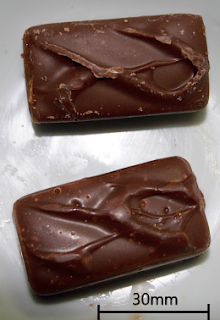
Figure B: An experimental Mars Bar (below) after the experiment showing no visible damage compared to the control bar (above).
The Mars bars showed no significant change in length as a result of their journey to the abyss (figure A; paired t-test: p > 0.05) and displayed virtually no signs of crushing damage at all (figure B) and the consensus on taste agreed that they tasted pretty much exactly the same as the control bar.

Milky Way

Figure C: The lengths of control and experimental Milky Ways before and after the experiment. Error bars show one standard deviation, p > 0.05.

Figure D: Milky Ways appeared to sustain more damage from the pressure than the Mars Bars.

Just like the Mars bars, the Milky Ways showed no obvious change in length after the experiment (figure C), but there were more obvious signs of having been crushed by the pressure (figure D). The taste panel agreed that the experimental Milky Ways were 'wet and disgusting'.

Maltesers

Figure E: Control Maltesers (left) compared to an experimental set (right).

As expected, the journey to the abyss had the most dramatic effects on the Maltesers which were so crushed from the trip that the experimental ones couldn't be measured (figure E). Strangely enough, these were popular with the tasting team who agreed that despite the fact that they were wet and rather salty, they were actually quite pleasant in a strange, chewy way. 

Milky Way Stars

Figure F: Experimental (left) compared to control (right) Milky Way Stars. Funnily enough, no-one was willing to try eating the experimental ones.

Figure G: Mean lengths of Milky Way Stars from each packet. Error bars show one standard deviation, p < 0.05. 
These were badly affected by water leakage and resembled a weird chocolatey soup (figure F). One of the experimental packets contained chocolates that were significantly smaller than the control (figure G; GLM: p < 0.05), but the other experimental groups showed no difference. Not surprisingly, we drew the line at tasting these and so we'll never know if they were still edible!

Starburst
Figure H: Mean width of control (red) and experimental starburst. Error bars show one standard deviation, p < 0.05.

Figure H: Experimental (left) compared to control (right) starbursts.
Figure I: An opened starburst showing the extent to which they had dissolved. 
Finally, we have the starburst. These were also badly affected by water leakage which turned them into a strange soup. Measurements taken on the wrapped sweets showed that the experimental groups were significantly wider than the control (figure H; GLM: p < 0.05), but this is likely due to the fact that they were pretty well liquefied by the time we got them (figures I & J). As with the Milky Way Stars, no-one was willing to try eating these so what salty, wet, melted Starbursts actually taste like will sadly remain a mystery.

Conclusions
It's pretty clear from this short study that the biggest issue with sending Mars funsize sweets into the abyss is non-waterproof packaging, which was generally considered a bad thing in terms of the appeal and taste of everything except the Mars Bars which seemed to be entirely unaltered by the whole affair. The effects of pressure weren't particularly exciting on anything except the Maltesers which seem to have been completely crushed by their descent to 4800m. 

Also, although students will eat almost anything, it seems that salty, melted chocolate soup is a step too far!

Thanks
Thanks to Claire, Alice, Tish and John for daring to taste these!


* Socks make useful impromptu containers because: a) SOMEONE always has an old sock they don’t mind sacrificing to the cause and b) it’s relatively easy to shove cable ties through wool.

Wednesday, 11 July 2012

The internet's back on! Time for a blog...

And so, after 4 days of travelling, we finally made it to our sampling stations in the Porcupine Abyssal Plain first thing on Sunday morning ready and excited to start working! ...At least the morning shift were up and ready to go - my afternoon (1500-0300) shift was a little slower to get out of bed, most of us just managing to get ourselves up in time to eat lunch! Still, I can't complain; doing the backshift is DEFINITELY the better option compared to having to get out of bed at 3am every day (I don't do mornings). 

It is quite interesting seeing how different people deal with the shifts though. Most people on board I think would prefer to work the 1500-0300 shift if they had the choice, but some definitely deal it better than others. For me, if I had to get up for 3am I would still wake up feeling like crap no matter when I went to bed, whereas working the backshift until 0300 is absolutely no problem and only took a day or two to get used to. It's also helping the productivity (well, that and the extremely intermittent internet connection means I can't get too distracted too easily!), which always helps ease the PhD Fear back a little bit!

Mud + Science = Fun times for all.

Anyway, aside from settling into our shifts and getting to know everyone else on the ship, we've been getting stuck into a lot of megacoring work, which basically involves sending a corer to the seabed armed with 8-10 plastic tubes, which will be forced into the seabed then mechanically sealed up and hauled all the way back up ready to be measured, cut into slices, preserved and stored. All in all, the whole cycle takes around 7 hours (5 hours to send the gear down and back up and about 2 hours to process) so there's plenty of time to escape off to do some work or watch a film in between cores (or bizarrely, learn how to play cribbage), which is nice because it's not the most exciting work! It's one of those team-effort type jobs though so it's a pretty good laugh at least.

Autosub on the back deck. 

Autosub (our AUV or 'Autonomous Underwater Vehicle') is still being prepared for it's first launch later this afternoon (Wednesday) so keep your fingers crossed that it all goes well! The plan for the next few days is to send it down to take a few test photographs on the seabed so we can make sure it's all working the way it's meant to, and then it will rise up to about 100m off the sea floor and conduct the first part of an acoustic mapping survey which will take about 6 days to complete. So there won't be any fishy photos to look at for a while yet I'm afraid!

A little mystery tern floating by on its own private polystyrene island. Click to enlarge.

In wildlife news, there hasn't been much in the way of bird life out here except for this little mystery tern which floated past the ship yesterday on a little polystyrene island. As usual, I've got very little idea what this is, but it doesn't look like any of the British species I've seen before. Anyone out there got any ideas?

Maybe a fin whale? A group of about 5-6 whales passed our ship yesterday but no-one could tell what species they were.

We also saw a lot of whales yesterday too, which was very exciting! They were pretty far away, but they were pretty big (one was probably >15m, though I'm horrible at estimates. Definitely bigger than a minke though) and we think they might have been fin whales. One day I'll buy an ID guide and be able to say for sure what all these things are that we find out here!


Thursday, 5 July 2012

To the Abyss!

The tug boat maneuvering us out of port and away from NOC

Leaving Southampton behind us (click to enlarge)


And we're off! After a relatively calm day yesterday to arrive and get acquainted with our new living arrangements aboard ship, we finally left Southampton harbour at lunchtime today, heading out on our way to the abyss! So far we've not really had much to do aside from going through the normal start-of-cruise safety and science briefings, and getting to know the other scientists and the ship so it's been quite a relaxed couple of days (which is a nice break after the chaos of preparing for the cruise!).

We have old skool life jackets!

Inside the life raft, listening to why abandoning ship would be all kinds of horrendous.


We've got a long way to go to get to our study site in the Porcupine Abyssal Plain (PAP), which means we'll not be arriving until first thing on Sunday, with a stop-off en route on Saturday to collect some 'shallow' mud and water samples (from only 1000m!) for one of the other PhD students. Saying that, there's plenty of preparatory work to be done to make sure all our equipment and computers are working properly and that we're ready to cope with the deluge of data we're expecting to get from the AUV on a daily basis. All being well, I'll have amassed an absolutely enormous collection of photographs by the time we come home (current estimates suggest we'll be getting 40,000 photos per day from each of the two cameras), and will have photographically and acoustically mapped an area of seabed of approximately 50km2, making this the largest and most detailed attempt to map a deep-sea area ever conducted! Hopefully with all those photographs I'll get to see plenty of fish!

Southampton harbour (click to enlarge).
In slightly different news, I've also been asked to keep the official NOC blog up to date as we go through the cruise, so if reading one blog by me isn't enough, you can pop over to http://picturingthedeep.blogspot.co.uk/ and read that one too! Though in fairness, the NOC one will be written by lots of different people, so you'll at least get plenty of variety!

Tuesday, 3 July 2012

Heading back to sea!

I still can't quite believe I'm getting to spend so much time on research cruises this year! It's all very exciting! After the success of the Changing Oceans 2012 expedition which I was involved with last month, I've managed to grab a brief two weeks on shore before heading off tomorrow to join the RRS Discovery (the 50 year-old one, not the new one!) in Southampton to take part in the AESA cruise at the Porcupine Abyssal Plain (NE Atlantic). To give it its full title, the cruise is called:

Autonomous Ecological Surveying of the Abyss:
Understanding Mesoscale Spatial Heterogeneity
at the Porcupine Abyssal Plain

Which sounds pretty damn cool, doesn't it?

Essentially the aims of this cruise build on work we conducted on the RRS James Cook last August which aimed to collect preliminary data about the distributions of megafaunal animals across the abyssal seabed using an autonomous underwater vehicle (AUV). Unlike an ROV (a remotely-operated vehicle), which is constantly linked to the research ship via a tether cable and controlled directly by operators on-board, AUVs are pre-programmed with a route and details of what instruments to use and when, and then dropped into the sea where they will automatically follow their programming and then return to the surface when they're done. The lack of a tether system means that not only is the base ship able to continue working with other gears while the AUV is in the water, but that AUVs can access areas that are inaccessible to ROVs (e.g. under ice).

Image taken from the NOC website: http://www.noc.soton.ac.uk/aui/autosub.htm

The plan for the AESA cruise is therefore to send the AUV (we're using AUTOSUB) down to the abyss and send it off to conduct photographic surveys of the seafloor to assess how different animals are distributed across the seabed and how they respond to changes in the seafloor habitats (e.g. surrounding and on top of abyssal mud mounds) over a relatively fine scale. As usual, I'll be studying the fish that we see on the forward-facing camera, while others will be studying the invertebrate fauna using a downward-facing camera. Continuous surveying of physical environmental parameters will also be done at the same time. And while the AUV is busily collecting all its data, we can continue to work on collecting, processing and storing... you guessed it! Mud! I can't wait!

Deep-sea mud. Glorious, glorious, mud!

Since the RRS Discovery is the older sister-ship to the RRS James Cook, I'm expecting that we should have some (albeit limited) internet access while we're away, so I will hopefully be able to keep you updated on our progress and any other cool things we see as we go through the cruise. Also, since my research typically involves video & photographic analysis rather than lab work, I've made up a little side project of my own to run alongside the serious science! ... But you'll have to wait and see to find out what it is!

Sunday, 1 July 2012

OpenROV Project

I found this link today via the blog at Southern Fried Science and I've been geeking out about it for a large chunk of the afternoon as a result. I very much want to have a tiny homemade ROV in my life! ROVs (remotely operated vehicles) are essentially extremely versatile underwater robots which are used in virtually every aspect of underwater exploration. Depending on the size of the ROV, they can be used at all ocean depths and may have manipulator arms and other sensors to allow them to carry out precision tasks at depth without any of the risks associated with sending a human being down (either a diver or in a submarine) to do the work directly. At their most basic, ROVs consist of a housing containing electronics and a camera (so the operators can see where they're going), a tether cable (to link the ROV back up to the control computers on the boat), and motors (so the ROV can actually move around). Unfortunately, as useful as these machines are for conducting surveys, they are generally extremely expensive but that's where the OpenROV project comes in.

The OpenROV project. Image from openrov.com  (Photo Credit: Sam Kelly)   

The idea behind OpenROV is to create an open-source ROV which can be built and used by anyone for a relatively low price, but which is good enough to provide useful scientific data. The design they have at the moment is relatively untested, but apparently has a theoretical depth rating of 100m and has enough space to carry a range of extra sensors and cameras depending on what you want to use it for, so it looks like it could be pretty flexible. The designs and software are freely available on their website right now so if you have access to a workshop and a computer you can go and make one today if you wanted to and because it's open source, it's also supported by a worldwide online community who are able to contribute to the development of the project in a very real way, with software coding and testing the different builds. In my view, this kind of project is what the internet is brilliant at - bringing people together from all around the planet to work on an idea and then sharing it for free. Also, if you support it on kickstarter you can get a Jacques Cousteau-style red beanie!

This is one project I'll be keeping an eye on to see how it turns out. As someone with extremely limited abilities on the electronics side of things I'll be interested to see how this works once it's fully tested and ready-built models start becoming available - it could be a very cool piece of kit.