Showing posts with label ocean. Show all posts

Saturday, 20 May 2017

Surveying the deep Gulf of Mexico


I have the coolest job!


Over the last couple of weeks I've been out at sea on a research cruise in the northern Gulf of Mexico to study the fishes that live in the deep pelagic realm. The pelagic ocean really includes everything above the seafloor and offshore from the coast, but my interest for now is in the animals that live far offshore, at depths down to 1500 m.

Hell, even the coolest alien in cinema was inspired by the deep oceans. This is Phronima in the home it carved from a salp, and it was the inspiration for the xenomorph in Alien movie. 

Every single fish that lives in the open ocean lives in an environment with no hard surfaces at all. For their entire lives, a pelagic fish's experience of the environment is defined in gradients of temperature, light, food and water currents. They live surrounded by the bioluminescent flashes of other animals; they may eventually find a mate, or they may end up as a meal for one of the many fish-eating predators that lie in wait for them in the darkness. Many of the fish that live in the deep-pelagic ocean live short, but fascinating, lives.

I've been working on deep-sea fishes for a while now. My PhD research involved trying to work out how the large deep-sea fish that live across the seafloor are distributed in different places and why. Now, I'm trying to work out where fish live in the deep in the water column and why, using a unique long-term dataset from the northern Gulf of Mexico (check out the DEEPEND website for more info). Of course, species names in a database don't mean a great deal on their own, so going out on this cruise gave me my first chance to put a few fresh faces to some long and hard-to-pronounce names. And there were certainly some memorable faces...

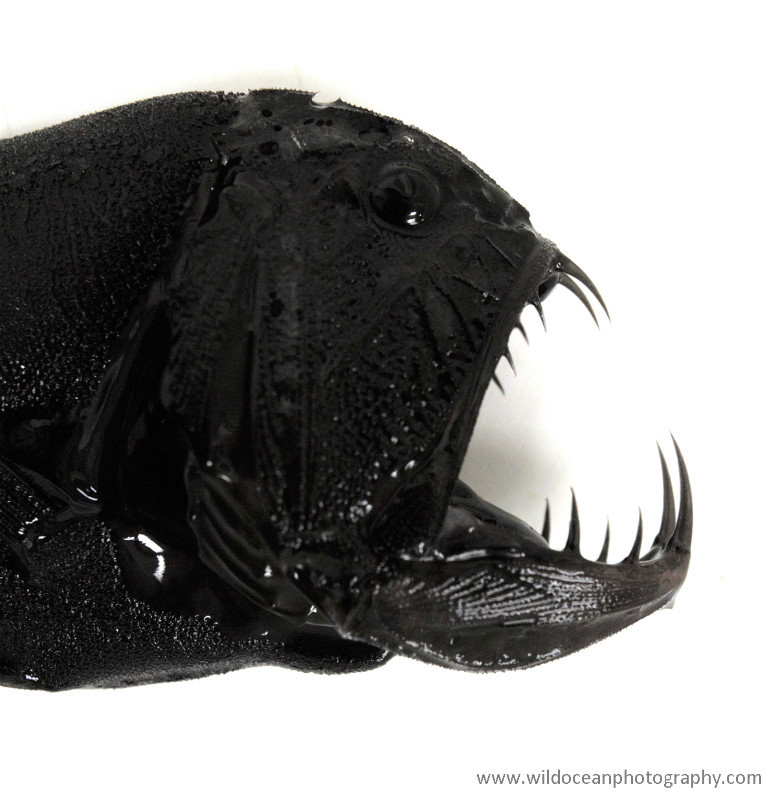
This is a fangtooth. How it got its name is truly one of the world's great mysteries.

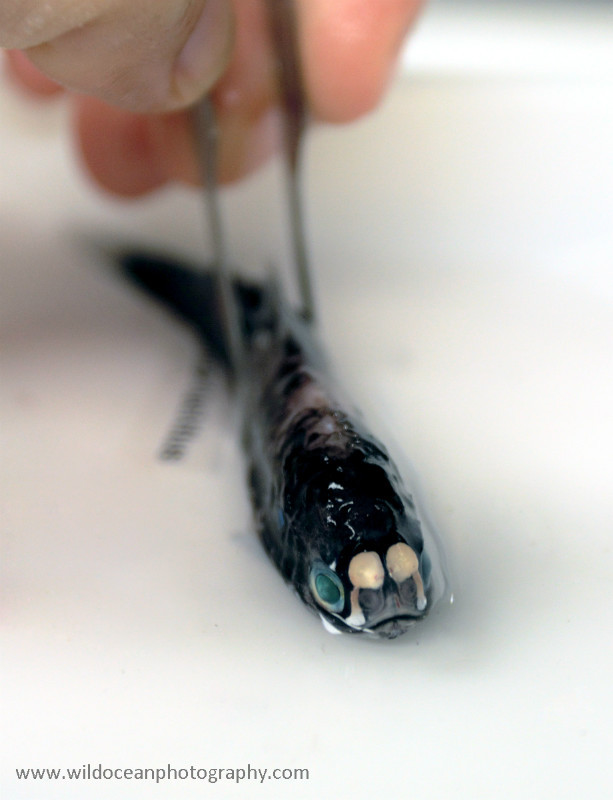
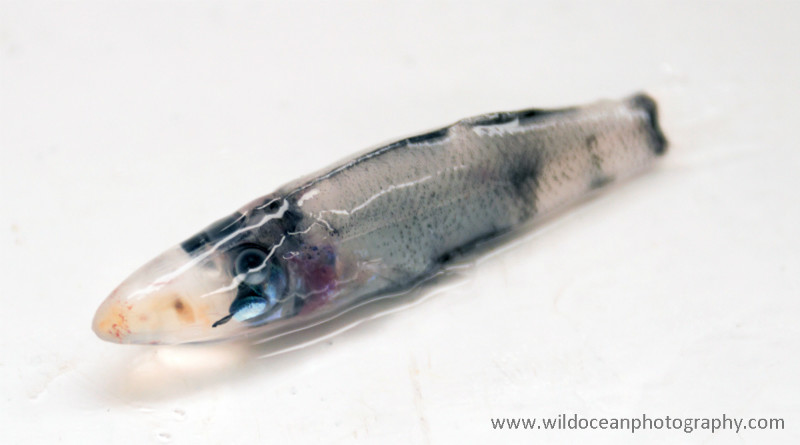
Lanternfishes have the ability to produce light on their faces to help them spot prey

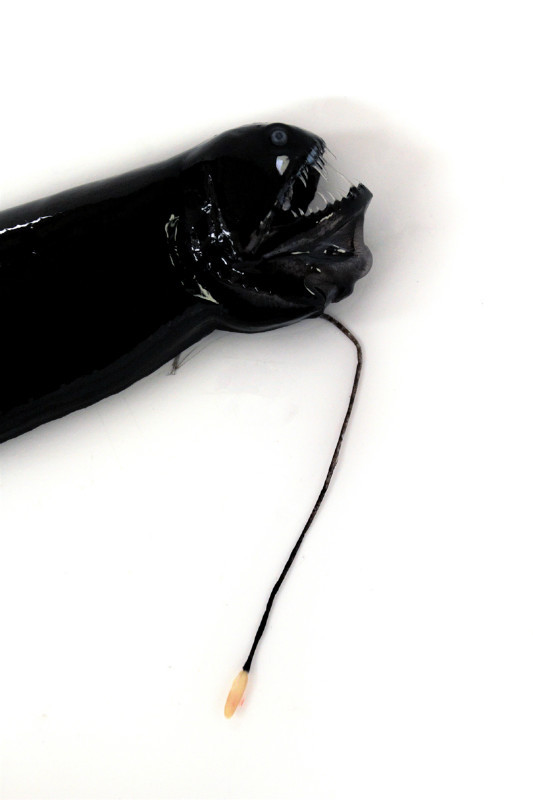
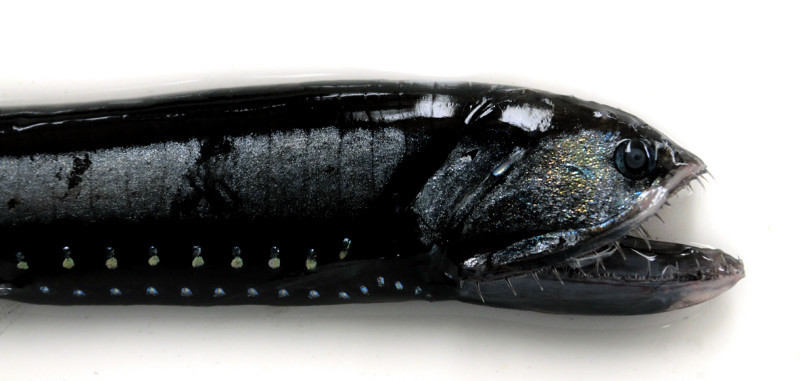
A dragonfish with its long, glowing lure for attracting prey and "headlights" on its cheeks for spotting prey

As cool and weird as these animals are, all the work we're doing out here has a serious purpose. Over the last decade or so, deep pelagic research has had a bit of a resurgence. While the deep-pelagic realm is probably one of the least understood anywhere on Earth, the more we learn about it, the more important it seems to be; and sometimes in surprising ways. For example, many deep-pelagic animals (like the lanternfishes for example) migrate to the surface waters every night to feed on microscopic animals (zooplankton), and in doing so, actually move huge quantities of carbon away from the surface ocean (where it could be released to the atmosphere again as carbon dioxide) and into the deep oceans (where it can be stored for up to 1000 years!). Since high levels of atmospheric carbon dioxide are one of the primary causes of our current global warming problem, it's easy to see how deep-pelagic fishes could be incredibly important animals for us to learn more about.

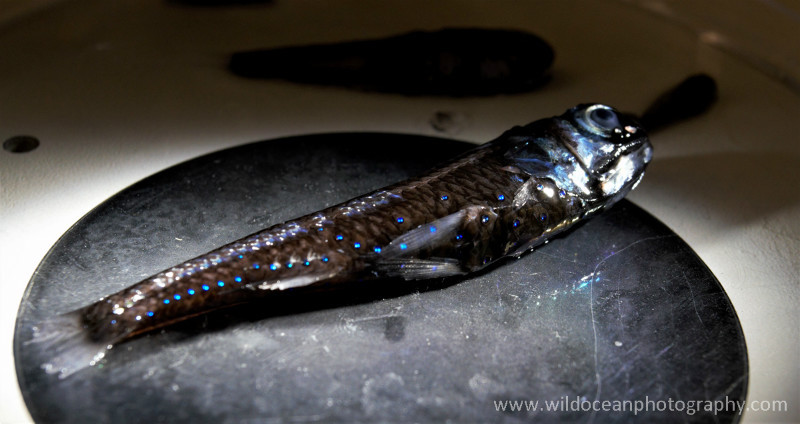
Many lanternfishes have light-producing organs along their bodies. This fish was still glowing when we brought it on board!

These strange-looking "bristlemouth" fishes (Cyclothone spp.) are the most abundant vertebrates on Earth.

Of course, as with most of the deep sea, we have plenty of questions to ask and not a lot of data to answer them with. This makes the catches we're collecting through DEEPEND all the more valuable and gives us a huge opportunity to start digging into some cool and really fundamental questions (like "what even lives down there and how?" and "why do deep-sea fishes live where they do?"), as well as some really complex ones (like "how will future human activities affect how deep-sea ecosystems work?"). Trying to find sensible answers to these sorts of questions is what I do when I'm back in the office. For now though, I'll leave you with a few more photos of some of the stranger fish we caught!

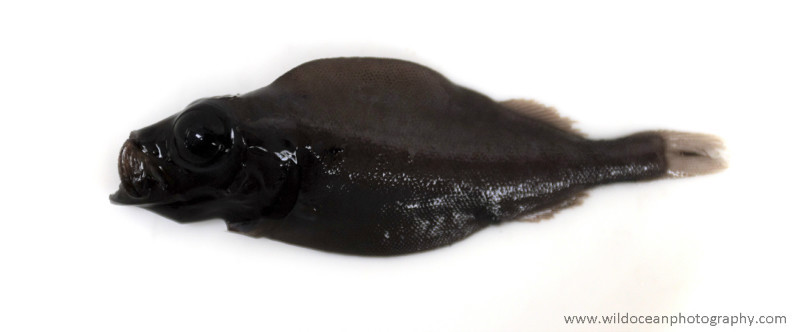
Barreleye fishes like this one have eyes that can see upwards and sideways at the same time! This is a glasshead barreleye (Rhynchohyalus natalensis).

This is a "Tubeshoulder" fish (Platytroctes apus). These have little tubes on their shoulders that they can use to shoot bioluminescent fluid out of, presumably as a defense mechanism.
A predatory bristlemouth (Sigmops elongatus). They have light organs along their belly for camouflage and a rather impressive set of teeth to eat things with!

Those of you who have been following my Facebook and Twitter will already have had a bit of a sneak preview of the other photos I took while I was out on the ship, but in case you haven't seen them, most of the photographs of the deep-sea animals are now also online on the website in the Deep Sea part of my "Specimen Photography" gallery.

Saturday, 22 October 2016

The Florida Mullet Run

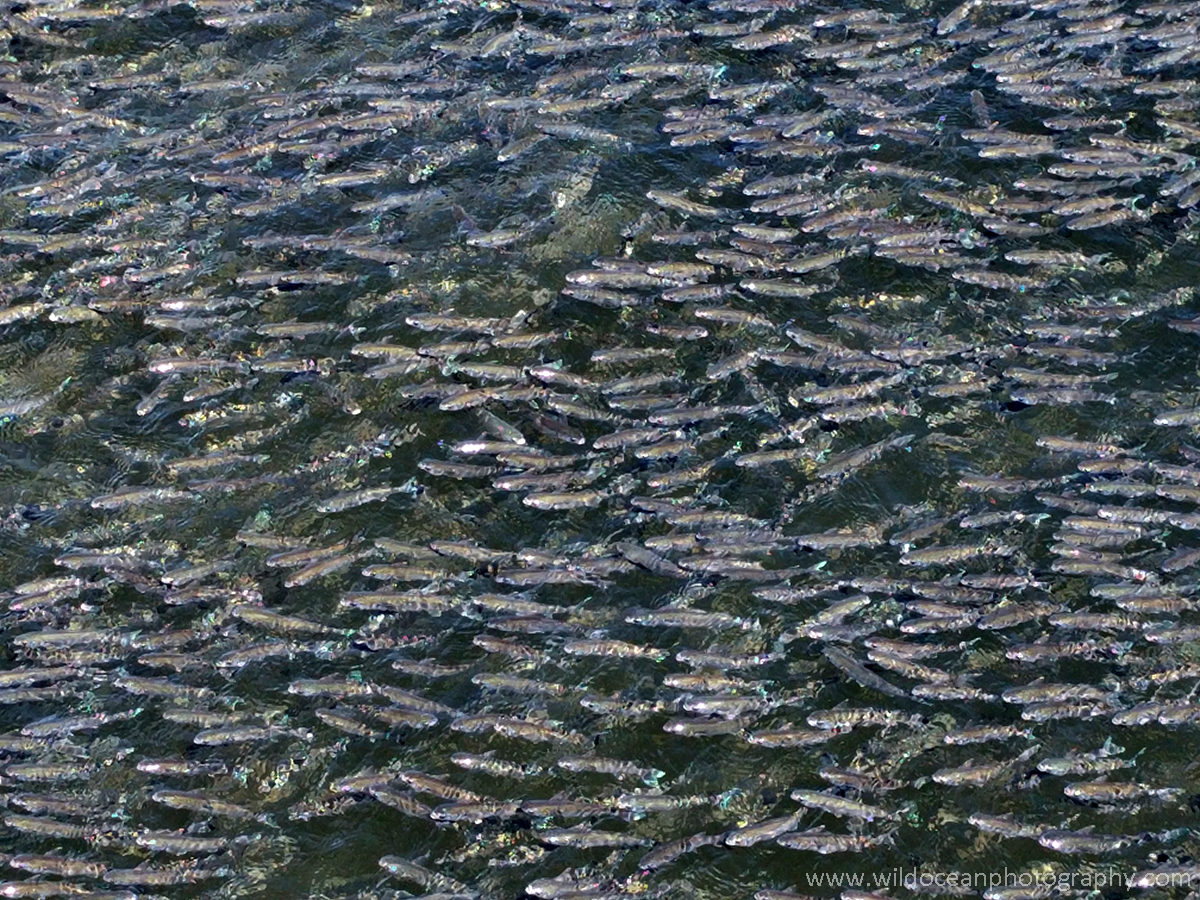
Every autumn a phenomenon called the 'Mullet Run' sweeps up the Florida coast, as millions of finger-size mullet head southwards along the Atlantic coast, following the warmer waters and their food supply of algae. It's quite a sight! As these small fish migrate, they form vast schools in order to avoid their predators, which in turn follow along to feed. If you've ever seen wildlife documentaries of the sardine run in South Africa, this is something similar.

Finger mullet in the harbour. The density of fish was this high everywhere!

Mullet being chased (and eaten) by jacks

This year's mullet run happened to pass my work last week. Overnight, the water in our boat dock became literally packed with mullet, as predatory jacks and pelicans chased them around the seawall at the entrance. Unfortunately, I only had my phone with me to take pictures with, but they at least give you a bit of an idea of just how many fish were all jammed in there together!


By the next day, I had my big camera in work with me, but it was all over and the majority of the fish had moved on (of course!). Hopefully next year!


Monday, 29 June 2015

"Days at Sea"

We've been busily working away out here over the past few days, getting well stuck into our nights of mud-sampling while bobbing around in the tail end of a tropical storm. The rough weather has made it too difficult to do much willdife-watching, but it has given me a bit of extra time to work on a photo project I've been adding to for a few years now but never quite got round to finishing that I'm provisionally calling "Days at Sea".

25 days on the Atlantic Ocean. Click to view a larger version.

When I went on my first deep-sea research cruise, I took a photo out of my cabin window every day. At the time, it was largely just a nice way to track the number of days we'd been out on the water (and how many we had left!), and it very quickly turned into a bit of a habit which has turned into a rather large archive of images. Out here, there is virtually nothing out here to see except and endless expanse of sea and sky, but for such a simple view it's amazing how variable it can be from hour to hour and day to day. This project is intended to be a reflection of the dynamic and relentless beauty of our oceans.

Tuesday, 23 June 2015

To the Abyss (again!)

It's nice to be back at sea!
 
Last Friday, I left Glasgow with one of my fish-ecologist colleagues to join the RRS Discovery for another cruise to the Porcupine Abyssal Plain (PAP) long-term survey site. This is my fourth trip out to the PAP in as many years now, and I must admit it's really nice to be back on a ship! 

Me and Jo, ready to sail!

Leaving a wet and rainy Liverpool

The main purpose of this particular cruise is to service the PAP monitoring buoy and download the data that it's been collecting for the past year. This includes oceanographic data (e.g. current speed, water temperature, salinity), as well as collections of the sinking particles of dead organisms, biological waste and other organic and inorganic materials that make up the "marine snow" which fuels the vast majority of deep-sea ecosystems.

The Porcupine Abyssal Plain (PAP) study site is about 300 miles south-west of Ireland

Recoving the PAP buoy in 2013

Taking a ship 300 miles offshore is not a simple (or cheap!) task however, and there's no point coming all the way out here just to service a buoy and go home again so we've got a full contingent of scientists ready to make the most of the opportunity to collect their own data from the PAP site. On this particular cruise, we've got teams who are interested in understanding how mid-water bacterial processes and communities are influenced by "marine snow" particles, as well as researchers who will be studying the plankton communities and oceanography of the site. We even have a couple of holographic cameras which can automatically assess the sizes of all the particles in a tiny patch of seawater and rebuild an image of them all! 

Some photos from the last time I was out here to fish in the abyss. Hopefully this time we'll catch even more!
 
As exciting as the midwater research is though, I am here with Jo Clarke from Glasgow University to go fishing! We're working with the "benthic" (seafloor) ecologists from NOC to help collect deep-water animals from the seabed using mud cores, grabs and a trawl. We're really here for the fish, so we're mainly interested in the fish samples, and are here to make sure that they get identified, processed and recorded correctly for any future work that might be done on them. We'll also be helping out with all the other benthic sampling that needs to be done which will largely involve dealing with a lot of mud!

Sieving mud samples isn't so bad really!

The megacorer is one of the standard sampling gears for getting good quality sediment and animal samples back from the seabed. We'll be seeing a lot of it over the next few days!


So far we've had a pretty quiet start to the cruise. We met the ship in Liverpool and then spent a couple of days steaming south to Falmouth so some repairs could be done to one of the ship's thrusters while we were still near the coast. Happily that all went well, and we reached Falmouth just after midnight on Sunday for a mini crew-swap before starting our voyage to the PAP site. We should arrive there tomorrow, ready to start working!

Sunday, 15 September 2013

Wildlife in the Wind and Rain

The change from summer to autumn has not been subtle this year. Over the course of the last week we've gone from warm, sunny summery days to ... well, today! As always, please click on the images to see them properly.

I can't imagine why no-one was sitting on that bench...

Still, bad weather can make for some cool conditions to take photographs in. A lot of wildlife won't come out when the weather is really bad, but one of the nice things about photographing coastal and marine wildlife is that a little bit of wind and rain doesn't tend to faze them very much!

Breaking waves hammering the seawall at Troon.

So despite the forecast, today we headed south of Glasgow to check out the beaches at Troon (one of my regular spots), Irvine and Ardrossan and see what we could spot. The tides shouldn't have been that great for getting close to the birds (it was low water around lunchtime), but the horrible weather had forced plenty of them high up the shore so we had some nice opportunities. Along the shore we had turnstones and redshanks:

Turnstone on the beach at Troon

Redshank on the shore

I was hoping to find eider ducks sheltering from the weather at the harbour, but they were apparently elsewhere today. There were eight grey seals hanging around though:

Grey seals in the fishing harbour

Of course, it was at this point in proceedings that my trusty 7D + 300mm F4L + 1.4x T.C. combination reached the limits of its weather-sealing abilities and stopped working. No screen, no autofocus, no buttons... Oops. Fortunately a towel dry and a few minutes on the car heater seemed to fix it so hopefully there's no lasting damage. At least it was freshwater for a change too! Of course, that wasn't the only thing I did to the camera today...

After Troon we headed further up the coast to Irvine just in time for the sun to break through for a few minutes.

The beach at Irvine

Having spotted a couple of eider ducks, I decided to test my new walking shoes and climb down the seawall to get down to the beach for a closer view. Neither the boots nor the photo worked particularly well unfortunately and I have a couple of rather large new dents in the camera (and my arm). It still works though, so happy days!


Another couple of war wounds to add to the collection. I suspect I'll never, ever be able to sell this camera second hand. Ever. 

The eider duck photos turned out to be pretty boring in the end, but fortunately a curlew came to the rescue and stood in the sea spray and sunshine for a little while:


A curlew in the waves

After this set I decided I'd left enough blood and camera metal on the shore at Irvine for one day and we headed back to Glasgow via Ardrossan and Largs past some more promising looking beaches which I will check out next time I have a free day.

So all in all it was a pretty successful day out really! Nothing broken, nothing (very) flooded and a few decent photos to show for it. I might wrap the camera in a plastic bag next time right enough.

Sunday, 23 December 2012

New Zealand Part 4: Kaikoura

Kaikoura (click to enlarge) 

So for the final leg of my short trip, I headed over to Kaikoura for some more wildlife-watching and photography, via a lovely bay called Birdlings Flat.

The beach at Birdlings Flat (yes I got my feet wet).

Terns wheeling in the sunlight under the cliffs

Kaikoura is a little town on the east coast, but what makes it interesting from a marine point of view is the fact that the continental shelf edge lies very close to shore, so it's possible to get out into very deep water without having to travel very far. The consequence for this for wildlife is that you get a lot of oceanic and pelagic species close in to the coast so you can go out and see whales, dolphin and albatross without having to spend a whole day on the sea. Not that I would mind, but short trips are usually better for casual tourists, and the tour operators certainly make the most out of the commercial opportunities...

One of several whale-watching boats operating out of Akaroa.

The sperm whale's tail as it dives into the depths.

The boat trip in Akaroa with the Hector's dolphins was a really good one - the skipper and crew were dead friendly and provided us with a load of information about the dolphins, which were billed as the star attractions really, but then took us further on and told us all stories about the geology, local culture and went out of their way to find us more wildlife to see, pointing out all the seabirds as we passed. In Kaikoura, you have the choice of three tours - one for whales, one for dolphins and one for albatrosses. I went on the whale and albatross boats though the whale trip was a wee bit disappointing.

The sperm whale surfacing to recover itself after its deep dive to hunt.

Sperm whale snot!

We did see a sperm whale though and while the guides were very knowledgeable about the whales and told us a lot about their lifestyle and the habitat, they didn't make any real effort to show us anything else or tell us about the other wildlife in the region, even with loads of birds flying past us while we waited for the whale to resurface. It was certainly ok, but I would argue it probably wasn't worth the money in the winter months. Maybe when the humpbacks etc. come back in the summer they have busier trips, but as it was, it was a long time to sit on a boat waiting for a single whale!

A fairy petrel

A sooty shearwater

A great petrel
Terns nesting on the shore

The 'Albatross Encounter' was better and took us out as a far smaller group (there were only six of us on board). The skipper knew his stuff and kept moving us around to find the different species and made sure to help us get the best photographic opportunities as well which was cool. From my point of view, this was the first time I'd seen an albatross (and yes, they are MASSIVE!) and it was probably one of the best opportunities I've seen to get good images of pelagic birds. Usually to see petrels and shearwaters, you need to be far out at sea, which generally means you're on a big ship and elevated pretty far above the water. To be on a small vessel so really close to the water's surface was great (if a bit rolly!) and was brilliant for the photography.

We even came across a pod of dusky dolphins

Dusky dolphins swimming by the boat

Back on shore, Kaikoura has some gorgeous scenery and a beautiful coastline, where you can find plenty more coastal birds and seals if you spend a little time looking for them:

A dead tree on the shore at Kaikoura

A heron feeding in the rockpools

Sadly, Kaikoura was the last stop on my trip and after another short three days it was time to catch the ferry again and head home. All in all, I only managed to see a tiny part of New Zealand, but it is such a beautiful country I have no doubt I'll be going back again sometime (whenever I feel like I can face that horrendous flight again!) to see some more of the country and do a spot of diving!

Hope you all have an excellent break over Christmas and a brilliant New Year! See you all in 2013!


Saturday, 22 December 2012

New Zealand Part 3: Akaroa


The speed machine!

So after a couple of days in Abel Tasman, I headed down to Christchurch to pick up a hire car and then it was off to Akaroa, which is a small town nestled on the west coast of the South Island in the crater of an extinct volcano. The middle of the crater is well below sea level and is open to the south, which creates a large natural harbour (Akaroa in Maori means 'long harbour') which in turn makes it a great place to see a huge variety of coastal wildlife, even in the town itself.

Canada geese on the shore in the town.

A Pied Cormorant (Phalacrocorax varius) in a tree in the town centre. 

One of the attractions of Akaroa as a place to view wildlife is the presence of a pod of 1000 Hector's Dolphins, which are one of the smallest and rarest species of dolphins in the world and are exceptionally cute! So on my day in Akaroa I booked a trip out on a wildlife tour boat to go and see them for myself, and I wasn't disappointed! 

A Hector's Dolphin popping up to breathe.

Three Hector's Dolphins swimming by our boat.

And as well as the dolphins in the main harbour area, further out along the coast there was plenty more to see:

A spotted cormorant making a surface dive

A blue penguin. These little birds are extremely rare and skittish around the boats - we managed to sneak up  on this  one while it was on the surface between dives, but most didn't stay around long!

A male fur seal, snoozing regally on the rocks.

A mother seal sleeping near her new pup.
After a far-too-short couple of hours on the boat, we headed back to shore and I took the chance to drive around some of the little single-track roads running around the summit of the crater and out to some of the more hidden beaches around the outer coast of the peninsula. The views were absolutely stunning!

Looking out to sea from the summit road around the Akaroa peninsula.

Looking out to sea over Le Bons bay.